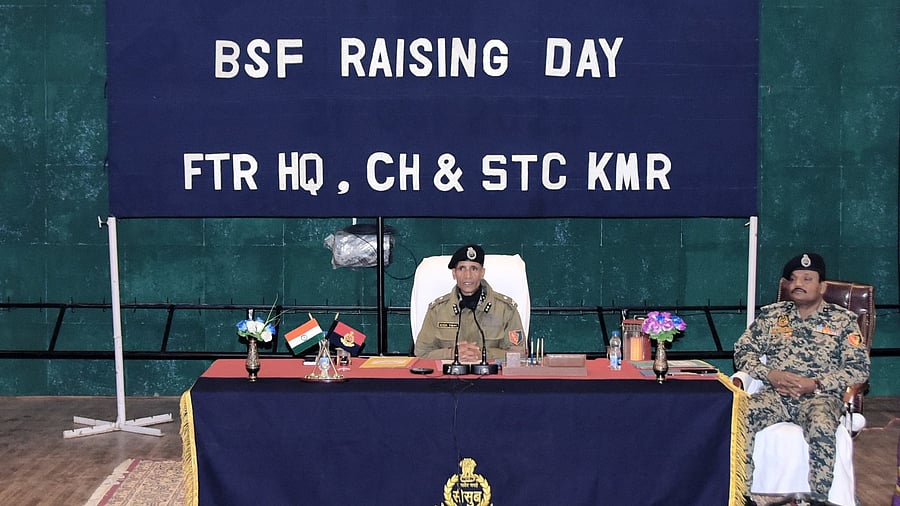
BSF Kashmir Frontier chief Ashok Yadav addresses a media conference.
Credit: X/@BSFKashmir
Srinagar: As 2025 draws to a close, security forces along the Line of Control (LoC) in Kashmir say militant infiltration attempts have declined. But officials warn the threat persists — especially as militants reportedly shift tactics and routes following the crackdowns under Operation Sindoor.
Border Security Force (BSF) Kashmir Frontier chief, Ashok Yadav, said that infiltration bids this year have been thwarted thanks to coordinated efforts by the BSF and the Army.
“Infiltration attempts by terrorists from Pakistan-occupied-Kashmir have not succeeded due to alertness of security forces and use of modern surveillance gadgets along the LoC,” Yadav told reporters, here.
Earlier this year, he said, the force foiled two infiltration attempts. “These efforts are part of a broader area domination — combining ground patrols, intelligence inputs and night vision or thermal surveillance tools,” Yadav said.
While May 2025 Operation Sindoor targeted terror infrastructure across Pakistan and PoK, reportedly destroying multiple militant launch pads, Yadav acknowledged that many forward positions were destroyed, “but some launch pads remain active.”
“The anti-infiltration grid is very strong,” he said, but added that militants are adapting — shifting some camps deeper, changing routes, and waiting for favourable weather to make a move.
Indeed, a recent report by the BSF claims that more than 70 terror launch pads — believed previously destroyed — have been relocated to “depth areas” inside Pakistani territory.
Winter worries and persistent launch pads
Security agencies caution that the onset of winter — heavy snow, fog, and limited visibility — historically increases risks of infiltration, as militants seek to exploit difficult terrain and reduced patrols.
Yadav also noted that despite fewer infiltration attempts this year, intelligence continues to indicate the presence of terrorists stationed at LoC launch pads opposite Indian positions — waiting for the “right moment.”
Public statements from the BSF emphasise that infiltration attempts this year are “down significantly” compared to previous years. Yet, officials have not released detailed data: number of attempts, exact sectors, breakdown of aborted vs. successful infiltrations, or how many militants remain in or near launch pads.
For now, the BSF-Army grid remains tight, boosted by surveillance gear, ground patrols and intelligence coordination. But with winter setting in and militants reportedly adapting, security agencies warn the threat remains real.