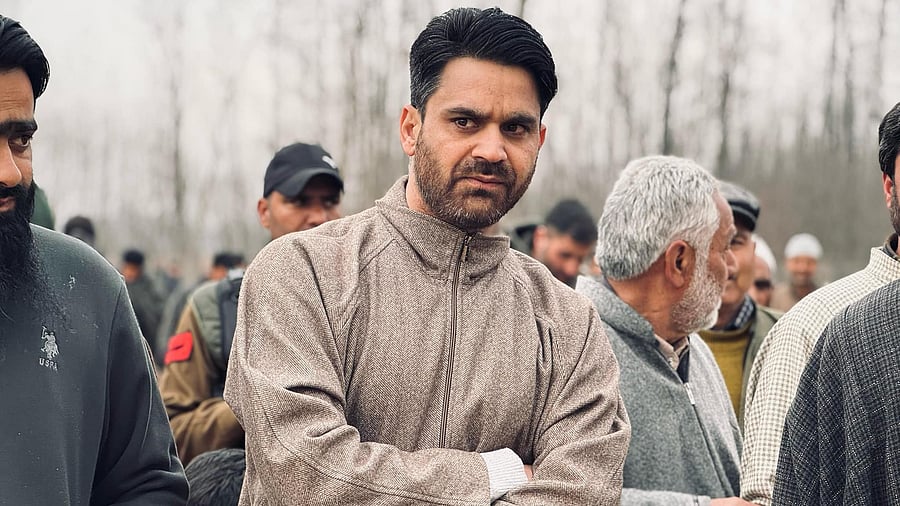
Peoples Democratic Party (PDP) legislator Waheed Parra
Credit: Facebook/Waheed Parra
Srinagar: As armed violence in Jammu and Kashmir recedes to its lowest levels in decades, a far deadlier crisis has quietly overtaken it. Cancer, according to official health data, is now claiming many more lives every year than conflict-related violence, marking a decisive shift in the region’s mortality landscape.
The contrast was highlighted this week by People’s Democratic Party (PDP) MLA Waheed Parra, who drew a sharp comparison between deaths caused by cancer and those resulting from decades of conflict. In a post on X, Parra said cancer had killed around 67,000 people in the last five years, while the conflict in Jammu and Kashmir had claimed the same number of lives over three decades.
"The biggest battles are often the ones we don’t see. Families, especially the poor, are forced to sell land and assets to seek treatment outside Kashmir because local hospitals are over burden or lack capacity. This is health and governance crisis that cannot be ignored, @CM_JnK. Government needs to address this crisis,” he said.
Parra’s intervention carries personal weight: his father died of cancer in 2024.
Conflict deaths: official and unofficial figures
The official death toll from the conflict in Jammu and Kashmir stands at around 47,000 since 1989, a figure cited by government agencies and reflected in official records. This includes civilians, security personnel and militants killed in over three and half decades of violence.
Separately, unofficial estimates — largely advanced by separatist groups and some civil society organisations — place the death toll at around one lakh. These figures remain contested and are not backed by a consolidated, verifiable official database.
What is undisputed, however, is that conflict-related fatalities have sharply declined over the past years, with annual deaths now largely remaining in double digits, a fraction of what the region witnessed during the peak of militancy in the 1990s and early 2000s.
Cancer deaths far exceed present-day conflict toll
In contrast, cancer deaths have surged. Data from the Union Health Ministry and the Indian Council of Medical Research (ICMR) shows that Jammu and Kashmir reports over 12,000 new cancer cases every year.
Between 2018 and 2022 alone, more than 35,000 cancer-related deaths were officially recorded, translating to roughly 7,000 deaths annually — a figure that far exceeds the number of people killed each year due to militancy in recent times.
“Conflict deaths were episodic and linked to a particular phase,” said a senior oncologist in Srinagar. “Cancer deaths are continuous, rising and largely driven by systemic gaps in early detection and treatment.”
Healthcare system under strain
Doctors say the high mortality rate is closely linked to limited cancer care infrastructure within the Union Territory. The Sher-i-Kashmir Institute of Medical Sciences (SKIMS) and Government Medical Colleges in Srinagar and Jammu remain the primary oncology centres, but are overstretched and face shortages of oncologists, radiotherapy machines and specialised treatment facilities.
Health officials estimate that a huge number of cancer patients from Jammu and Kashmir travel outside the UT — mainly to Delhi, Chandigarh and Mumbai — for chemotherapy, radiotherapy and advanced surgeries. Long waiting periods for radiotherapy within J&K often delay treatment, reducing survival chances.
The financial burden is severe. “Families sell land, livestock or exhaust savings to fund treatment outside Kashmir,” said an oncologist. “In conflict-related deaths, there were compensation mechanisms. For cancer, families are largely left on their own.”
Shifting priorities
For decades, Kashmir’s human cost was measured in bullets and bombings. Today, health experts argue, disease has become the greater threat.
“Violence once dominated death statistics,” said a senior public health official. “Now cancer kills far more people every year than conflict does.”
As Jammu and Kashmir transitions away from large-scale violence, doctors and policy experts warn that failure to prioritise cancer care could result in a human toll that overshadows even the long years of conflict.