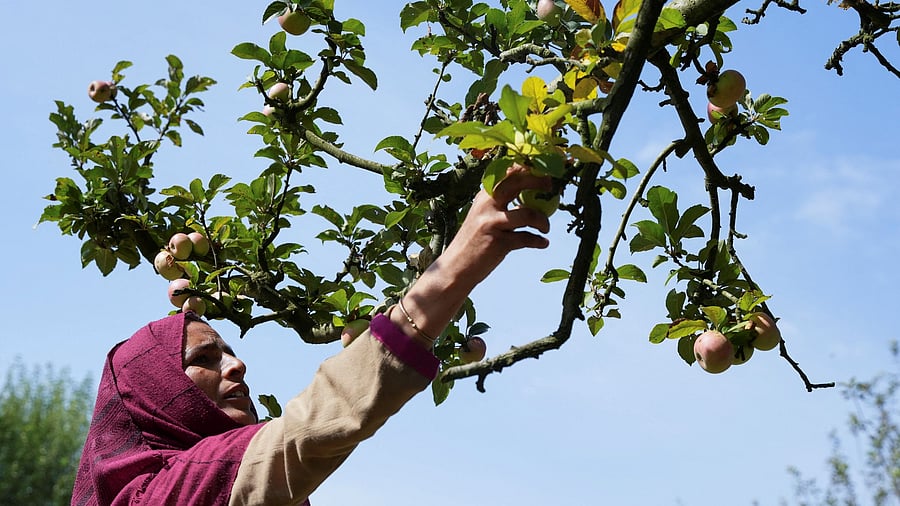
File photo for representational purpose.
Credit: Reuters Photo
Srinagar: Kashmir’s apple orchards, the backbone of the Valley’s economy and a source of nearly 75–78 per cent of India’s apple production, are under renewed scrutiny as health experts and lawmakers raise concerns over the risks posed by prolonged pesticide use for orchard workers.
These concerns do not extend to consumers eating apples, but are concentrated among individuals who handle chemicals daily.
The House Committee on Environment of the Jammu and Kashmir Legislative Assembly, chaired by CPM legislator M Y Tarigami, recently convened a meeting with scientists, medical professionals, and horticulture officials to examine the occupational hazards faced by orchard workers.
Discussions focused on decades of pesticide application and its potential link to serious health problems, including malignant brain tumours, in those directly exposed.
Studies conducted at the Valley’s tertiary-care hospital - Sher‑i‑Kashmir Institute of Medical Sciences (SKIMS) - found that a significant proportion of patients with primary malignant brain tumours were orchard workers or residents living near orchards.
Most had decades of exposure to pesticides such as chlorpyrifos, mancozeb, and captan — chemicals recognized internationally for their neurotoxic and carcinogenic properties. Experts emphasise that these findings reflect occupational exposure, rather than a risk to the general population or consumers of apples.
Doctors also report additional health concerns among orchard workers, including chronic respiratory problems, skin irritations, and early signs of kidney or metabolic dysfunction. Trace levels of pesticides have been detected in the blood of some workers and nearby residents, highlighting that exposure extends beyond those directly applying chemicals.
Orchard practices in Kashmir involve frequent spraying to protect crops from pests and fungal diseases, sometimes every 10–12 days during the growing season. Many workers cannot afford personal protective equipment such as gloves, masks, or goggles, increasing the likelihood of chronic exposure.
Environmental advocates also note that pesticide runoff can affect soil and water, though the primary health risk remains with the workers themselves.
Apple cultivation is critical to Kashmir’s economy, sustaining around seven lakh families. Lawmakers, however, are clear that protecting the health of orchard workers must be a priority. “We are not questioning the apple economy, but we cannot ignore the health of those who toil in it daily,” Tarigami said.
The committee has recommended steps including annual health screenings for orchard workers, monitoring of pesticide application, education on safe handling practices, and research on long-term health effects.
Experts believe that adopting safer pesticide practices and providing protective gear could significantly reduce health risks for workers without affecting production.
As Kashmir continues to thrive as India’s apple bowl, the focus remains on ensuring that the livelihoods and well-being of orchard workers are safeguarded, highlighting the need for careful management of chemical use in orchards.