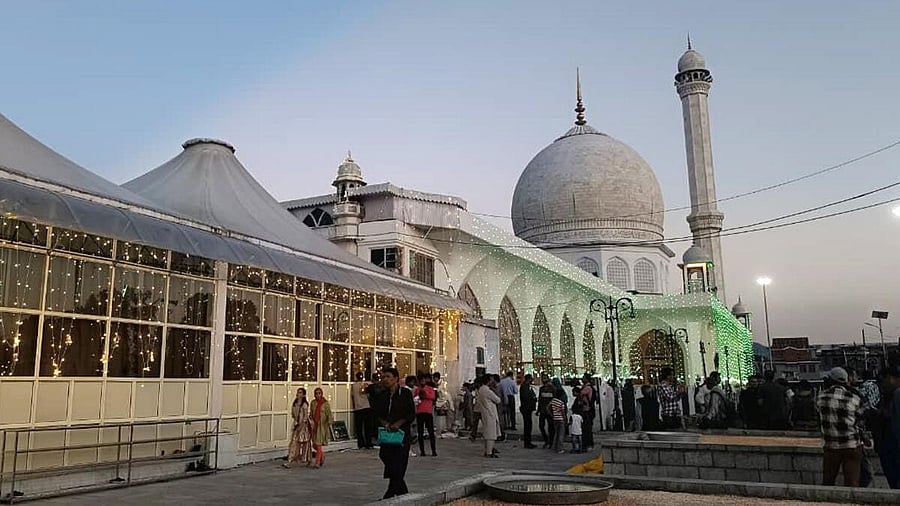
People at the Hazratbal mosque.
Credit: PTI photo
Srinagar: A police-led exercise to collect information on mosques, seminaries and religious functionaries across Kashmir has sparked political criticism and concern among sections of the religious leadership, even as the administration has defended the move as a routine regulatory measure.
Officials say the exercise is aimed at updating official records, ensuring transparency and preventing the misuse of religious spaces, and is not intended to interfere in religious practices.
According to officials familiar with the process, the data being collected includes basic institutional details, administrative structures and information on religious functionaries.
They said similar records exist for educational institutions, NGOs and other public-facing bodies, and that religious institutions are not being treated differently.
The exercise has drawn objections from some religious organisations and political leaders, who have questioned the intent and scope of police involvement. They have sought clarity on how the information will be used and whether it could lead to surveillance of religious activity. The administration has maintained that the process is administrative in nature and within the framework of law.
A comparative look at practices in Muslim-majority countries suggests that formal state oversight of mosques is a common feature globally, often implemented through structured legal and administrative mechanisms.
In Pakistan, mosques are required to be registered either under the Societies Registration Act of 1860 or as trusts or waqfs. The process involves documentation such as land ownership records and identity proofs of mosque committee members, with oversight by provincial Auqaf departments or district administrations. A No Objection Certificate from the district administration is mandatory for new mosque construction.
Saudi Arabia follows a highly centralised model. The Ministry of Islamic Affairs, Dawah and Guidance oversees the planning, construction, maintenance and operation of most mosques. Imams are appointed and paid by the state, and mosque operations function within a national administrative framework.
Turkey’s Presidency of Religious Affairs, known as the Diyanet, manages and funds the majority of the country’s mosques, estimated at around 85,000, and employs imams as civil servants. While some mosques are built by communities, they are required to register as legally recognised associations or foundations and operate with government approval.
In Malaysia, Islamic affairs fall under the jurisdiction of individual states. Mosques are administered and registered through State Islamic Religious Councils and Departments, and no building can be designated as a mosque without written permission from the relevant council, ensuring compliance with planning and zoning regulations.
Egypt’s Ministry of Religious Endowments exercises strict control over mosque registration, administration and religious discourse, with the state appointing imams and supervising sermons as part of broader regulatory oversight.
In the Gulf, countries such as the United Arab Emirates and Qatar operate centralised systems in which mosques require official licences for establishment and operation, supported by documentation related to funding, land ownership and management. Imams and mosque staff are appointed through government bodies.
Indonesia, the world’s largest Muslim-majority country, also mandates formal registration of mosques as religious organisations or foundations with the Ministry of Religious Affairs, involving procedures at both local and national levels.
Officials in Kashmir argue that the current exercise is limited to data collection and falls well short of direct state control seen in many other countries. They emphasise that the government does not appoint imams, regulate sermons or manage mosque finances, and that the exercise is intended to strengthen administrative clarity and public order.
The administration has indicated that consultations with stakeholders may follow to address concerns and clarify the scope of the exercise. For now, the data collection drive continues amid ongoing political and religious debate.