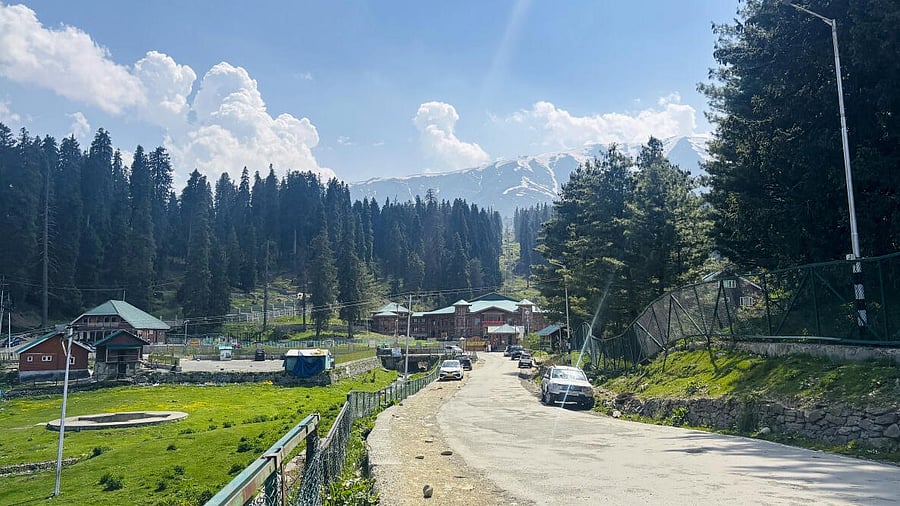
A near deserted tourist spot in Gulmarg, J&K.
Credit: PTI
Srinagar: Long before taps and pipelines reached Kashmir’s villages, natural springs—known locally as ‘nags’—were the lifeblood of the Valley.
From Verinag and Kokernag in south Kashmir to Sukhnag in central Kashmir, these springs supplied clean, cold water to households, farms and settlements for centuries. People planned their homes and cultivated fields around them and in districts like Anantnag and Kulgam, entire communities thrived on this free, perennial resource.
Some springs were even famed for their medicinal qualities, with elders recalling that water flowed steadily year-round.
Ghulam Ahmad, a 68-year-old farmer from Verinag, remembers, “There was no concept of water scarcity. If a spring slowed down, the village would clean its channel and protect the surrounding land.”
Collective maintenance and protection of recharge zones ensured springs remained a reliable source of potable water, even when rivers turned muddy after rains.
But today, many of these springs are drying up, signaling an environmental crisis quietly unfolding across Kashmir. The decline began gradually in the 1970s and 1980s, when the Public Health Engineering (PHE) department expanded piped water networks.
“As dependence on springs decreased, maintenance stopped and their natural recharge zones were left exposed. Construction of roads, concrete houses, and commercial buildings replaced fields and wetlands that once absorbed rain and snowmelt,” Ahmad lamented.
In Anantnag and Kulgam, springs that once fed streams now run dry by late summer. Pulwama and Shopian have lost several entirely. Residents say they now depend on tanker water during dry months, with women walking longer distances to collect drinking water.
Farmers struggle to irrigate kitchen gardens and paddy fields that once thrived on spring water. Ironically, piped water has not fully replaced the springs; supply disruptions, ageing infrastructure, and power cuts leave taps dry.
Environmental experts cite unregulated groundwater extraction as a key factor. With inconsistent piped supply, households increasingly rely on borewells, lowering groundwater that naturally feeds springs.
Climate change compounds the stress: warmer winters, reduced snowfall, and erratic rainfall mean slower aquifer recharge. Since 1980, average temperatures in Kashmir have risen by 0.8°C, glaciers have shrunk by up to 15%, and rainfall has stayed consistently below normal in recent years.
Mining and deforestation further disrupt the Valley’s hydrology. Rivers and springs face sedimentation, contamination, and altered drainage patterns. “Cement and limestone mining have long-term effects, including landslides and reduced groundwater recharge,” explains Dr. Sarah Qazi, hydrogeologist at Kashmir University.
Yet amid the crisis, efforts to revive springs are emerging. Environmentalist Manzoor Wangnoo’s Ehsaas campaign has restored four springs in Ganderbal and is working to rejuvenate the Amda Kadal Spring in Srinagar. Government initiatives like the Jal Jeevan Mission and Springshed Rejuvenation aim to secure Himalayan water sources, though large-scale revival remains slow.
The vanishing springs of Kashmir highlight a crucial lesson: modern infrastructure cannot replace the ecological resilience once embedded in traditional water systems. What sustained communities for centuries is now fading, and whether these springs flow again will depend on addressing groundwater misuse, unchecked construction, mining impacts, and climate stress—before silence replaces the Valley’s flowing waters.