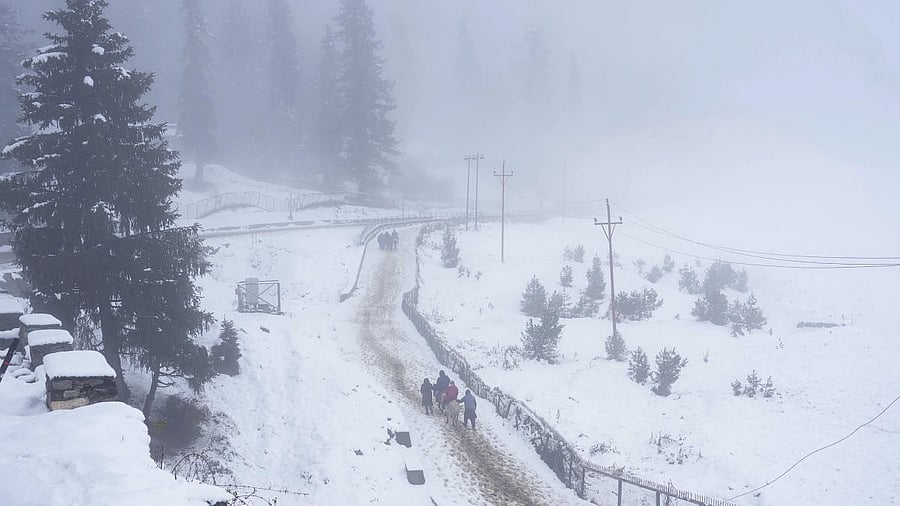
People walk through a snow-covered road at Gulmarg in Baramulla district of North Kashmir.
Credit: PTI
Srinagar: Kashmir’s winter tourism season, usually set in motion by the first heavy snowfall by mid-December, is unfolding this year in slow motion.
Hotel bookings across key destinations, including the iconic ski resort of Gulmarg, remain well below expectations as delayed snowfall collides with lingering unease following the April terror attack in Pahalgam.
For those dependent on winter tourism, the season was meant to be a turning point—a chance to recover lost ground after the April 22 attack in Baisaran meadows of Pahalgam, in which 25 tourists and a local were killed, rattling tourist confidence.
Instead, the Valley has entered peak winter without the one ingredient that reliably drives footfall: snow. The result is an unusual quiet across resorts that are normally buzzing with skiers, honeymooners and year-end holiday crowds.
Nowhere is the impact more visible than Gulmarg. From early December in a normal year, hotels here operate at near-capacity, with rooms booked weeks in advance and overflow spilling into nearby Tangmarg. This winter, however, hoteliers speak of vacant rooms and cautious travellers.
“By this time in December, it was difficult to find a vacant room in Gulmarg. This season, availability is not an issue at all,” said Abdul Majeed, a hotelier, attributing the lull to delayed snowfall and uncertainty after the Pahalgam attack.
While inquiries for Christmas and New Year have picked up, he said confirmed bookings remain only moderate. “Visitors are hopeful about snowfall, and so are we.”
The pattern is repeating across other winter destinations. Pahalgam and Sonamarg, which rely heavily on snow tourism for livelihoods ranging from hotels to pony services and transport, are also witnessing subdued footfall. Tour operators say many travellers are postponing trips rather than cancelling outright—waiting for visual confirmation that winter has truly arrived.
This hesitation reflects a shift in tourist behaviour. Industry players say travellers today track weather updates closely and are unwilling to commit unless snow is assured. “Every second call we receive is about snowfall,” said Rouf Tramboo, President of the Travel Agents Association of Kashmir (TAAK). “Tourists are keen but waiting for snow before they finalise their plans.”
Mushtaq Chaya, Chairman of the Jammu and Kashmir Hoteliers Club, acknowledged the slow start but struck an optimistic note. “Whether it’s Gulmarg, Pahalgam or Sonamarg, the bookings are minimal. Once it snows, we are sure the numbers will rise sharply,” he said, stressing that winter tourism in Kashmir is directly linked to snowfall.
Past experience supports that optimism. Even a delayed snowfall has often triggered an overnight revival, with last-minute bookings flooding in as soon as the mountains turn white. With weather experts predicting the possibility of light to moderate snowfall in higher reaches in the coming week, the tourism fraternity is watching the skies closely.
For now, Kashmir’s winter tourism remains in a holding pattern—poised between anxiety and hope, waiting for snow to restore both confidence and crowds.