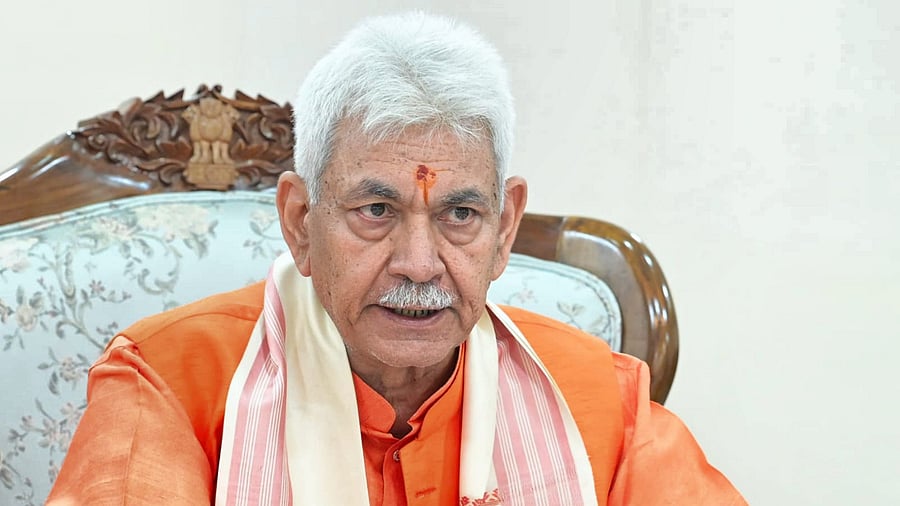
Jammu and Kashmir Lieutenant Governor Manoj Sinha.
Credit: PTI Photo
Srinagar: Jammu and Kashmir Lieutenant Governor Manoj Sinha has intensified the administration’s campaign against terror support networks operating within government institutions, ordering the dismissal of five government employees for their alleged links with banned militant organisations, officials said.
The terminations were carried out under Article 311(2)(c) of the Constitution, which allows the removal of government servants without a departmental inquiry when the authority is satisfied that such action is necessary in the interest of national security.
Officials said intelligence and investigative agencies had flagged the employees for alleged involvement in activities linked to Lashkar-e-Taiba (LeT) and Hizb-ul-Mujahideen (HM), even as they continued to hold positions of public trust and draw salaries from the state exchequer.
The latest action is part of a broader effort by the J&K administration to dismantle the overground worker (OGW) ecosystem and terror logistics networks believed to be embedded within civil institutions.
Since 2021, the LG’s office has repeatedly maintained that neutralising militancy requires not only counter-insurgency operations but also the removal of alleged facilitators operating under the cover of government employment.
The administration has, in recent years, also acted against prominent government employees with alleged terror links, signalling a widening of the crackdown beyond low-level operatives.
Among those dismissed were Syed Shahid Yusuf and Syed Shakeel Yusuf, sons of Hizbul Mujahideen chief Syed Salahuddin, who were removed from service in 2021 following intelligence inputs alleging their involvement in activities prejudicial to national security.
In the same phase, Assabh Khan, wife of jailed militant commander Bitta Karate, was also terminated. Officials have cited these cases to underline the government’s position that status, background or lineage will not provide immunity where credible security concerns arise.
Officials argue that invoking Article 311(2)(c) reflects the seriousness with which the administration views national security threats, though the provision has also drawn criticism from opposition parties and civil rights groups who have raised concerns over due process.
The government, however, maintains that the dismissals are based on credible intelligence and are legally sustainable.
The latest round of terminations underscores the LG administration’s stated policy of zero tolerance towards terrorism and its support structures, as Jammu and Kashmir continues efforts to prevent militant groups from exploiting institutional access and public resources.