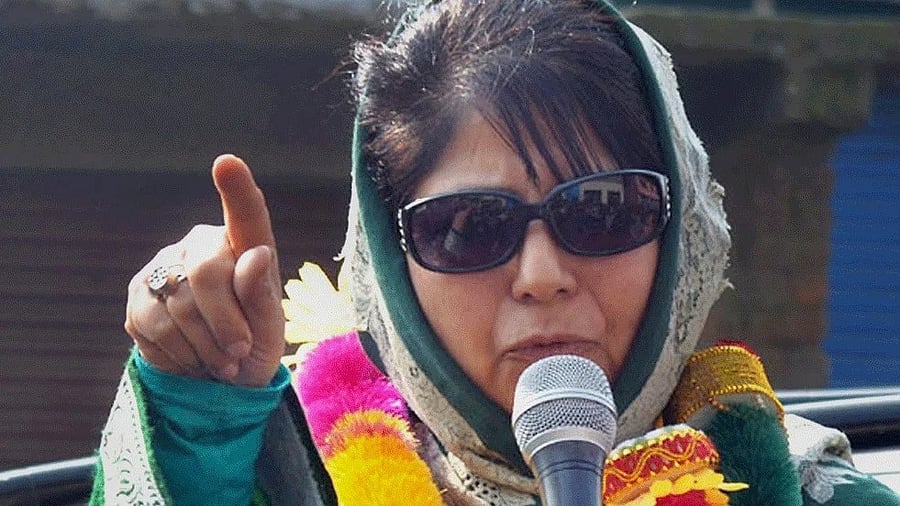
People's Democratic Party (PDP) Chief Mehbooba Mufti.
Credit: PTI Photo
Srinagar: More than six years after the abrogation of Article 370 and over a year after the restoration of an elected government in Jammu and Kashmir, the Union Territory’s (UT) youth remain among its most politically disillusioned groups.
Despite National Conference (NC) leader Omar Abdullah taking office as Chief Minister in October last year, many young people say the return of an assembly has not addressed deeper anxieties shaped by constitutional change, prolonged uncertainty and unmet promises of opportunity.
It is this widening disconnect that opposition People’s Democratic Party (PDP) president and former Chief Minister Mehbooba Mufti is now attempting to engage through a series of youth outreach initiatives.
In recent weeks, Mehbooba has convened two youth listening sessions—‘Kath Baat’ in Srinagar and ‘Gal Baat’ in Jammu—designed as open forums rather than conventional political programmes. The interactions come amid growing frustration among young people who feel that political engagement has narrowed since August 2019, even as official narratives stress stability and development.
“There is no dialogue with the youth in J&K,” Mehbooba said, underlining what she described as a serious communication gap between institutions and young people.
Linking alienation to psychological distress, she referred to a recent violent incident outside Kashmir. “A doctor who is supposed to be helping others kills innocent people at the Red Fort in Delhi on November 10. We need to understand what makes them anxious,” she said, arguing that the cost of ignoring unresolved anger and anxiety can be severe.
The sessions brought together students, job aspirants, young professionals and voices from different sectors, many of whom spoke candidly about unemployment, reservation policies, political disempowerment, rising drug abuse and what they described as systemic injustice.
Throughout the interactions, Mehbooba positioned herself less as a political authority and more as a listener. “The objective of the interaction was not to offer instant solutions,” she told participants. “I am not here to offer ready-made solutions. I am here to create a space for listening and understanding. In the absence of dialogue and shrinking public space, we must at least listen to our own people.”
Mehbooba said the outreach would not be limited to Srinagar and Jammu. “We plan to take such initiatives to the district level in the coming months,” she told DH, signaling an attempt to institutionalise the engagement rather than treat it as a one-off political exercise.
The outreach comes as the PDP continues to struggle for relevance after years on the political margins following the collapse of its alliance with the BJP in June 2018 and the events of August 2019. Political observers say the initiative reflects an effort to reconnect with a generation that feels alienated not just from opposition politics but from governance itself, including the current dispensation.
Critics argue that dialogue without policy leverage risks remaining symbolic. Supporters counter that in a region where political expression has steadily narrowed, creating spaces for conversation is itself a political act.
As Jammu and Kashmir navigates its post-election phase, Mehbooba Mufti’s youth outreach highlights a challenge confronting all political actors: restoring faith among young people who see little change between constitutional promises, electoral restoration and their lived realities.