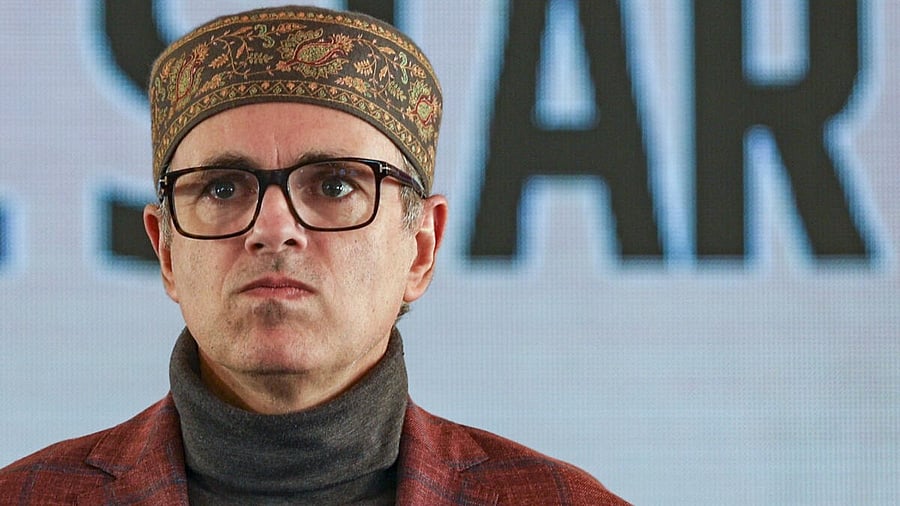
Omar Abdullah
Credit: PTI Photo
Srinagar: Chief Minister Omar Abdullah’s remark that he “cannot ask Jammu and Kashmir youth to work outside” following recent attacks on Kashmiri shawl vendors by rightwing elements in Uttarakhand and Himachal Pradesh has reignited a debate that goes beyond safety and into the core of governance: where are the promised jobs at home?
Multiple incidents of harassment and physical assault on Kashmiri shawl sellers and seasonal workers have been reported from hill towns in Uttarakhand and Himachal Pradesh, reviving fears that have long accompanied Kashmiri labour migration.
Omar’s response, acknowledging the insecurity faced by young Kashmiris outside the Union Territory, was widely seen as empathetic. Yet, it also exposed a glaring policy vacuum.
Opposition Peoples Democratic Party (PDP) leader Zuhaib Yousf Mir captured the growing unease in a post on X, noting that while the CM had rightly acknowledged the fear gripping Kashmiri youth, “the pertinent question is, if not beyond Kashmir, then where?”
He asked what future awaited young people at home and what concrete steps the elected National Conference (NC) government had taken since it came to power in October 2024 to create employment.
Election promise under scrutiny
Employment was central to the NC’s 2024 election campaign. The party repeatedly promised to generate one lakh jobs, presenting itself as a corrective to years of economic stagnation and high unemployment. More than a year after assuming office, however, there is little publicly available data to demonstrate large-scale job creation directly attributable to the government’s policies.
Recruitment notifications issued so far have largely been limited in scale and according to officials familiar with the process, include posts that were already in the pipeline before the NC came to power. The administration has not released any comprehensive statement detailing how many new jobs have been created since 2024, in which sectors, or over what timeline the one lakh target is expected to be met.
Independent labour estimates suggest that unemployment among educated youth in J&K remains among the highest in the country, with tens of thousands of graduates and postgraduates competing annually for a few thousand government vacancies. Private sector growth continues to be sluggish, with industrial expansion limited and new investment yet to translate into meaningful employment numbers.
Youth pushback
Among young Kashmiris, Omar’s statement has prompted frustration rather than reassurance.
“Safety is important, but safety without employment means nothing,” said Tufail, a 30-year-old B. Tech graduate from Srinagar, who has been searching for a job for nearly seven years. “If the government is telling us not to go outside, it must tell us where we are supposed to work here.”
A 24-year-old MBA passout from south Kashmir, said the fear of attacks outside Kashmir had already narrowed options for women. “Staying back only makes sense if there are real opportunities. Otherwise, it feels like we are being asked to accept permanent uncertainty.”
A fragile economic base
For years, migration for seasonal work—shawl vending, handicrafts, construction and hospitality—has acted as an informal employment buffer for Kashmir’s weak economy. The recent attacks in Uttarakhand and Himachal Pradesh have disrupted that outlet without any parallel expansion of local opportunities.
PDP’s Zuhaib Mir returned to this point in his post, arguing that Kashmiri youth were not seeking “speeches or sympathy” but “real opportunities, dignity, and a chance to build their lives in Kashmir.” He warned that discouraging migration without creating domestic alternatives risked deepening alienation.
A test for the NC government
Political observers say the controversy marks a moment of accountability for the NC leadership.
“In opposition, concern is rhetoric. In government, it has to translate into delivery,” said a Srinagar-based political analyst. “Acknowledging fear is necessary, but it does not substitute for employment policy.”
As criticism mounts, the demand from youth is increasingly specific: clear numbers, timelines and sector-wise plans for job creation. Until those answers are forthcoming, Omar’s statement—intended to reassure—has instead sharpened a question his government can no longer defer: if Kashmir’s youth are told not to leave, when will the promised jobs arrive, and where will they be found?