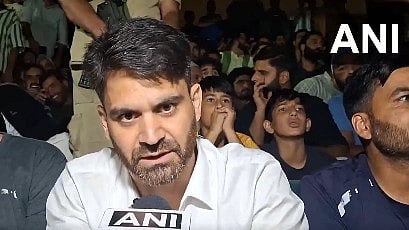
MLA Pulwama Waheed Para
Credit: X/@ANI
Srinagar: Opposition People’s Democratic Party (PDP) leader and legislator Waheed Para has given a notice to move a private member bill in the Jammu and Kashmir Assembly seeking to create a statutory framework for reconciliation, trauma healing and psychosocial rehabilitation in the Union Territory, which has witnessed decades of violence and political instability.
The Jammu and Kashmir Reconciliation, Trauma Healing and Dignity Bill, 2026 recognises conflict-related psychological trauma as a public health concern and proposes voluntary, confidential and non-coercive support services through the existing public health system.
While noting an acknowledged decline in violence since 2019, the Bill argues that the psychological and social consequences of prolonged conflict continue to affect individuals and communities, undermining trust, social cohesion and long-term stability.
It states that peace should be understood not merely as the absence of violence but as the capacity of society and institutions to address grievances through peaceful and restorative means.
The Bill’s preamble underlines that the human costs of the conflict have been experienced across communities, including Kashmiri Muslims, Kashmiri Pandits and members of the security forces, and cautions that unaddressed trauma can perpetuate cycles of fear, mistrust and inter-generational harm.
Under the proposed legislation, the J&K Health Department would serve as the nodal authority for implementation, with services delivered through existing government health institutions by qualified mental health professionals and trained support personnel. The Bill clarifies that clinical diagnosis and psychiatric treatment would continue to be governed by the Mental Healthcare Act, 2017, and that the proposed framework is intended to complement existing mental health laws.
The services envisaged under the Bill include psychological counselling, grief and trauma recovery programmes, family and community-based interventions, and professionally facilitated restorative dialogue. Participation would be voluntary, based on informed consent, and subject to safeguards on confidentiality and privacy.
The draft law also sets out specific rights for affected persons, including protection from stigma, discrimination or adverse consequences for seeking support. It emphasises that all measures under the Act would be humanitarian and non-punitive in nature.
According to the financial memorandum, implementation of the proposed legislation would involve an initial expenditure of ₹50 crore from the Union Territory’s Consolidated Fund for strengthening mental health services, training professionals and supporting community-based programmes. The Bill does not propose the creation of a new statutory authority, relying instead on existing institutional mechanisms.
Introduced as a private member’s Bill, its passage is uncertain. However, its tabling brings the issue of conflict-related psychological trauma and reconciliation into legislative focus at a time when governance in Jammu and Kashmir continues to be framed largely through security and administrative lenses.