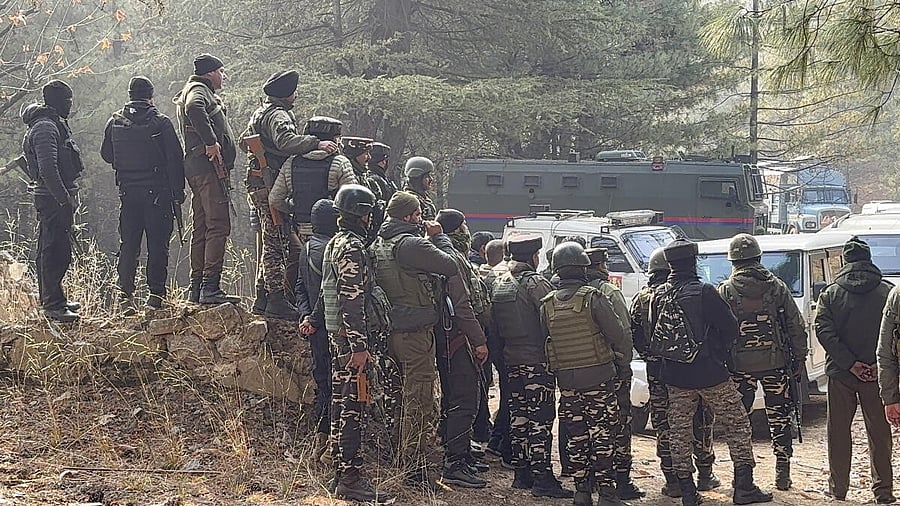
Security personnel conduct searches in the Hutmurah forest area as part of the ongoing investigation linked to the Delhi blast case, in Anantnag district, Jammu and Kashmir.
Credit: PTI Photo
Srinagar: The National Investigation Agency (NIA) on Tuesday intensified its probe into November 10 Red Fort blast in Delhi by conducting coordinated searches across south Kashmir’s Anantnag district, focusing on what officials describe as a growing “white-collar terror module” linked to educated professionals.
The searches were carried out in the Mattan forest belt, Qazigund, and another identified location, all of which were pinpointed by the arrested accused during interrogation, officials said.
Sources confirmed that the NIA team, assisted by J&K Police, brought two key suspects — Dr. Adeel Ahmad Rather and Jasir Bilal Wani — from Delhi to help identify the exact spots allegedly used for experiments, shelter, or concealment of materials related to the conspiracy.
Both men are in NIA custody for their suspected role in facilitating the suicide blast through logistical support, technical assistance, and coordination with handlers.
During the searches, investigators recovered a damaged gas cylinder from the Mattan forest area. According to officials, it is suspected to have been used in a test explosion or trial run before the Delhi attack, though forensic confirmation is pending. Electronic devices and other material were also seized from different locations and are currently undergoing technical analysis.
In recent weeks, the NIA has arrested several individuals — including doctors— in connection with what it calls a “white-collar radicalised module.” Among them are Dr. Adeel Ahmad Rather, Dr. Muzammil Shakeel Ganai, and other professionally qualified individuals. Officials believe the group provided ideological motivation, communication support, and discreet logistical assistance while maintaining outwardly respectable public profiles, making detection harder.
Another accused, Jasir Bilal Wani, also known as Danish, is alleged to have offered technical expertise, including knowledge of drones and mechanical systems, and is viewed as a key link between the conspirators and the ground-level operatives.
Tuesday’s raids in Anantnag form part of a broader crackdown across multiple south Kashmir districts, including earlier searches in Pulwama, Shopian, and Kulgam. Investigators are examining whether the accused conducted explosive experiments in forested or remote stretches before the Delhi attack, and whether they received support from additional locally embedded sympathisers.
Officials declined to disclose the full nature of the recoveries, stating only that the seized items were “significant” for mapping the conspiracy. The NIA believes that the module may have been in touch with handlers outside J&K, though the extent and direction of communication remain under investigation.
The agency is expected to conduct more searches as it pieces together movements, digital footprints, and possible trial-run locations linked to the suspects.