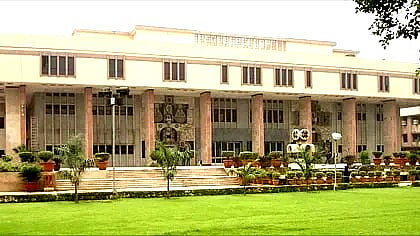
View of the Delhi High Court.
Credit: Delhi HC website
Srinagar: Two retired IAS officers—former Jammu & Kashmir Chief Secretary Arun Kumar Mehta and Gujarat-cadre officer Ashok Parmar—found themselves on opposite ends of a legal battle on Monday as the Delhi High Court heard Mehta’s defamation suit against Parmar and several media platforms.
The case, listed as before Justice Purushindra Kumar Kaurav, has rapidly become a telling example of how unverified allegations can ripple through bureaucratic and media circles with damaging consequences.
The court issued summons and notices to all defendants after detailed arguments led by Senior Advocate Puneet Mittal and his team, who appeared for Mehta. The suit seeks a permanent mandatory injunction and Rs 2.55 crore in damages for what Mehta calls “malicious and fabricated” corruption charges.
The matter will now be heard on February 3, 2026, for injunction proceedings, with evidence and cross-examination scheduled for March 9, 2026, before the Registrar.
At the heart of the dispute are letters circulated by Parmar claiming he had lodged serious corruption complaints against Mehta with the Central Bureau of Investigation (CBI) and the National Commission for Scheduled Castes (NCSC).
But these claims have collapsed under official scrutiny. Both the CBI and the NCSC, responding to RTI applications, categorically stated that no such complaints were ever filed.
Parmar had also claimed to have sent multiple letters as Chairman of the Bureau of Public Enterprises (BPE), yet RTI replies from the BPE show that none of these letters existed in its records, raising deeper questions about their origin and authenticity.
The Anti-Corruption Bureau (ACB) of Jammu & Kashmir dealt another blow to Parmar’s allegations. After examining his claims tied to governance reforms in the Union Territory, the ACB concluded that none of the allegations held merit.
The bureau found no irregularities in Mehta’s hallmark digital reforms, including BEAMS, PaySys, online sanctions, e-tendering and IT-based expenditure tracking—systems credited with dismantling discretionary loopholes and bringing transparency to public finance administration in J&K.
Mehta’s suit argues that Parmar’s accusations—whose estimated “corruption figures” veered wildly between ₹1,000 crore and ₹14,000 crore—reflect not just factual incoherence but a deliberate attempt to malign an officer who pushed for unprecedented financial transparency.
The petition emphasises that as Chief Secretary, Mehta had no control over contract approvals, which are handled by designated Contract Committees, and points out glaring contradictions, including allegations tied to periods when Mehta was not even posted in J&K.
The case now raises a larger institutional question that extends beyond the two retired bureaucrats: What safeguards exist to prevent public servants—current or former—from circulating unverified complaints capable of damaging reputations, derailing reforms and misleading the public?