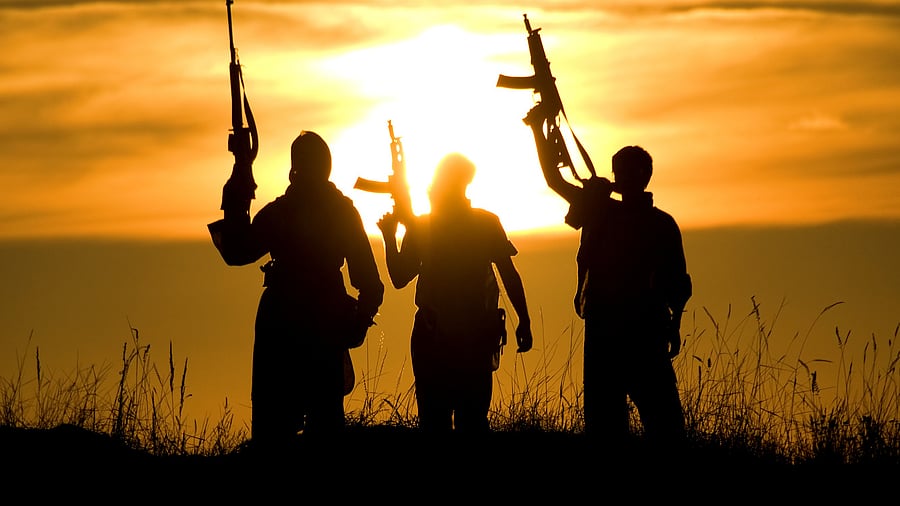
Representative Image for terrorists.
Credit: iStock
Srinagar: I first met Iqra in south Kashmir a few years ago, long after the gun salutes had fallen silent. She was two when her father, a local terrorist, was killed in the early 2000s. Her younger brother was still in her mother’s womb.
When the funeral crowds dispersed and the slogans faded, what remained was a young widow — pregnant, without income or protection — and two children whose lives had already been shaped by a war they never chose.
Between 1990 and 2018, terrorist funerals in Kashmir often became mass public events. Armed salutes, thousands of mourners, slogans echoing through villages — death was ritualised, performative, and projected as a symbol of resistance.
Reporting by mainstream local, national and international media often captured the spectacle, the rhetoric, the “heroism". What it rarely showed were the families left behind. Over time, and after visiting homes like Iqra’s, it became clear: These ceremonies normalised violence while offering no enduring support to those who survived.
No one stayed back for the families.
Iqra’s mother raised two children alone, stitching clothes, doing seasonal farm work and relying on sporadic help from relatives. The same neighbourhood that once turned out in thousands slowly withdrew. “People didn’t say anything openly,” Iqra told me. “They just stopped coming.”
This withdrawal is not anecdotal. A peer-reviewed study, “The effects of armed conflict on the families of slain members of armed groups in Kashmir” (International Journal of Emerging Technologies and Innovative Research, JETIR), documents these patterns in detail.
Dr Asima Hassan, who conducted field interviews across Kashmir, challenges the public mythology surrounding terrorist deaths. While killings were publicly glorified, families privately faced stigma, surveillance, and social exclusion. Nearly two-thirds of widows remained unmarried — not by choice, but due to social reluctance and fear of association.
Marriage prospects, particularly for daughters, became fraught, as families were seen as socially risky and economically burdensome.
I encountered this fear repeatedly while reporting. Families spoke in hushed tones. Doors closed faster once a father’s past was known. Children were rarely accused openly — but they were never allowed to forget.
Iqra grew up knowing her father only through fragments: A photograph, a carefully whispered name, and a history that followed her into classrooms and conversations.
Dr Hassan’s research shows that children of slain terrorists faced discrimination in education, employment, and marriage negotiations, often years after active violence had subsided.
Not married, Iqra now lives a quieter life. But grief has not ended; it has merely changed form. “I don’t miss him,” she said once. “I miss the life we never had.”
What is striking is how thoroughly families were erased from the public narrative of conflict. Gun salutes created icons, not safety nets. They mobilised crowds, not responsibility. Once the slogans ended, families like Iqra’s were left to bear the long-term costs of violence — alone, watched, and quietly judged.
As Dr Hassan writes, the real consequences of armed conflict “unfold slowly, inside homes, long after public attention has moved on.”
Years later, the afterlife of the conflict survives not in rallies or speeches, but in living rooms where widows grew old waiting for acceptance, and in children who learned early that some histories follow you everywhere. The public memory of militancy was loud and theatrical. Its private consequences were silent and enduring.
If Kashmir is to reckon honestly with its past, it must confront an uncomfortable truth: Violence did not merely take lives. It hollowed out families, normalised abandonment, and passed grief down generations. There was nothing redemptive in what followed — only loss, quietly carried by the living.