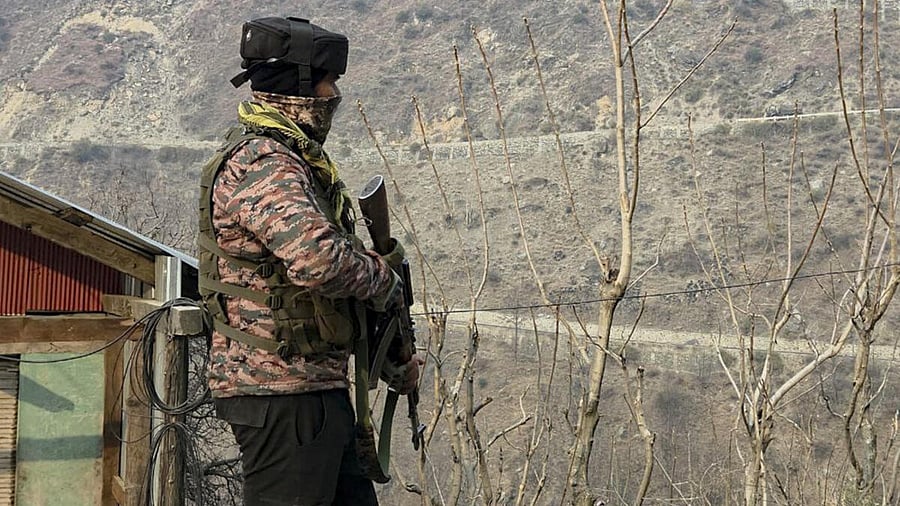
A security officer during a search operation to track down and neutralise terrorists, in Kishtwar district, Jammu and Kashmir, Monday, Jan. 19, 2026.
Credit: PTI Photo
Srinagar: “Where did the rice, eggs and ghee come from?” former Jammu and Kashmir Director General of Police Shesh Pal Vaid asked after terrorists were found relishing biryani inside a forest hideout in Kishtwar district — a discovery that has led to detentions and a widening probe into local terror logistics.
Several suspects have been detained as a massive search operation entered its third day on Tuesday in Sonnar village near Mandral–Singhpora, where one Army soldier was killed and seven others injured when security forces were ambushed with grenades and heavy gunfire on Sunday.
The operation followed intelligence inputs that terrorists were sheltering in the Chatroo belt. Security sources said the terrorists had established a fortified hideout and were not merely passing through. “Cooking biryani is not survival behaviour. It indicates planning, comfort and sustained supply,” a source said.
The encounter turned chaotic after grenades were hurled at the search team, disrupting the cordon. “The forces were split and fired upon from two or possibly three directions,” the source said, explaining how the militants exploited gaps to escape into dense forest cover.
A kitchen that points inward
Vaid said the hideout functioned as a base stocked with winter rations. “This was a full-fledged kitchen. These things cannot come from Pakistan,” he said. “Someone purchased them, transported them and stocked them.”
He noted that similar recoveries have been made at least four or five times in recent months, underlining the role of overground workers (OGWs). “In basic policing, something is missing. We need to go back to the grassroots,” he said, recalling how senior officers earlier camped in vulnerable areas until support networks were dismantled.
Detentions without disclosures
Several suspects from nearby villages have been picked up for questioning, particularly over food supplies and movement in the area, reports said. However, there was no official confirmation of arrests directly linked to the hideout.
The Chatroo–Mandral belt of the Chenab Valley has seen intermittent militant activity after years of relative calm. Security officials say militants here rely heavily on local supply lines to survive difficult terrain and evade detection.
Inspector General of Police, Jammu Zone, Bhim Sen Tuti, and Inspector General of CRPF (Jammu), R. Gopala Krishna Rao, have reached the encounter site and are camping there along with senior Army officers to supervise ongoing operations.
Following the ordinary trail
As search teams continue to comb the forests, investigators say the most revealing clues may come not from weapons, but from everyday items left behind. Rice bags, eggs and ghee point to shops, carriers and middlemen — a civilian trail that could explain how terrorists were able to live, cook and wait undetected in the forests of Kishtwar.