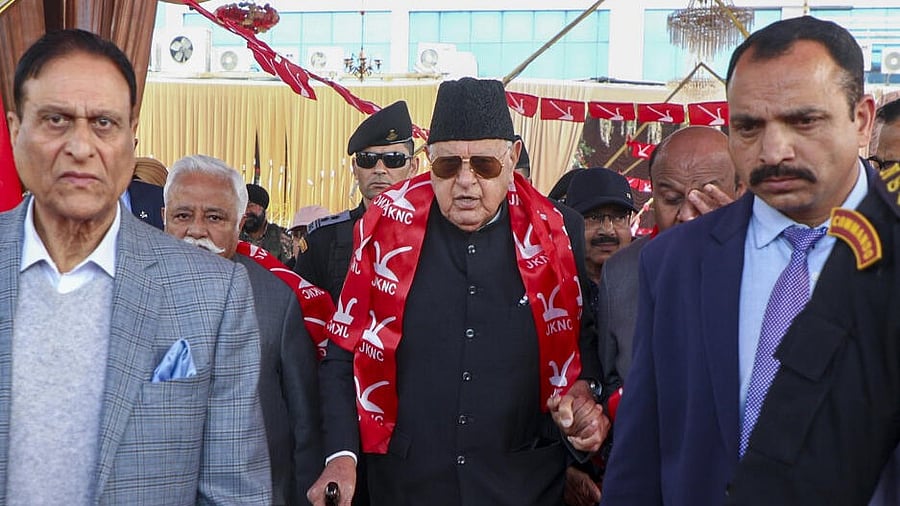
Farooq Abdullah
Credit: PTI Photo
Srinagar: Ruling National Conference president and former Chief Minister of Jammu and Kashmir Farooq Abdullah on Monday warned that communal hatred has been deliberately fuelled in the country in recent years to win elections, saying the sustained division between Hindus and Muslims poses a serious threat to India’s idea of unity in diversity.
Responding to Oscar-winning composer A.R. Rahman’s recent remarks on alleged “communal” bias in the Hindi film industry, Abdullah said the problem was far deeper and more widespread than Bollywood alone.
“There has been communal hatred in our country for some years now, created for electoral gains. Hindus and Muslims are being divided. What can we do if people want to fight on religious lines? This country belongs to all,” he said while talking to reporters on the sidelines of a party function, in Jammu.
Citing developments closer home, the former Chief Minister referred to the recent decision of the National Medical Commission (NMC) to revoke permission granted to the Shri Mata Vaishno Devi Institute of Medical Excellence (SMVDIME) to start an MBBS course.
The approval was withdrawn months after being granted, following protests by Hindu rightwing groups over the composition of the inaugural batch, which included 42 Muslim students, seven Hindu students and one Sikh, all admitted through NEET.
“The Muslim students were studying there purely on merit, but the permission was revoked only because of that,” Abdullah said, questioning the forces behind the agitation.
“Who were the people at the forefront of this protest? Who is spreading communal hatred in Jammu? Who is responsible? Who is shouting slogans to make Jammu a separate state? Why look at Bollywood—look at what is happening in our own state,” the NC chief said.
On Pakistan’s role in fomenting violence in Jammu and Kashmir, Abdullah said Islamabad would “never leave Kashmir” but asserted that the region’s political choice was settled long ago. “We fought against Pakistan. If we had to join Pakistan, we would have done so in 1947. We stayed with Gandhi’s Bharat,” he said, adding pointedly, “But is this Gandhi’s Bharat today? Who is fighting religious battles? Who is building temples for the killer of Mahatma Gandhi?”
Asked about the restoration of statehood to Jammu and Kashmir, the NC president said it would “come one day,” without elaborating further.
Abdullah also spoke about the return of displaced Kashmiri Pandits to the Valley, saying that while they are always welcome, the ground reality has changed over the decades. He said the younger generation of Kashmiri Pandits is unlikely to return permanently, as they are now settled outside the Valley, pursuing education and careers across the country.
“Their children have built their lives outside Kashmir and would come here only as visitors. This reality has to be acknowledged,” he said, adding that prolonged displacement has deeply affected generations of Kashmiri Pandits, particularly those who grew up away from their homeland and developed strong social and professional roots elsewhere.
He recalled that efforts were made in the past to facilitate the return of Kashmiri Pandits, with assurances of rehabilitation and security, "but many did not come back and subsequent political developments further altered the situation."
Abdullah’s remarks on the Pandit community came on a day when displaced Kashmiri Pandits observe January 19 as ‘holocaust day’ to mark their exodus from the Valley in 1990 following threats and targeted killings by Pakistan-sponsored terrorists.