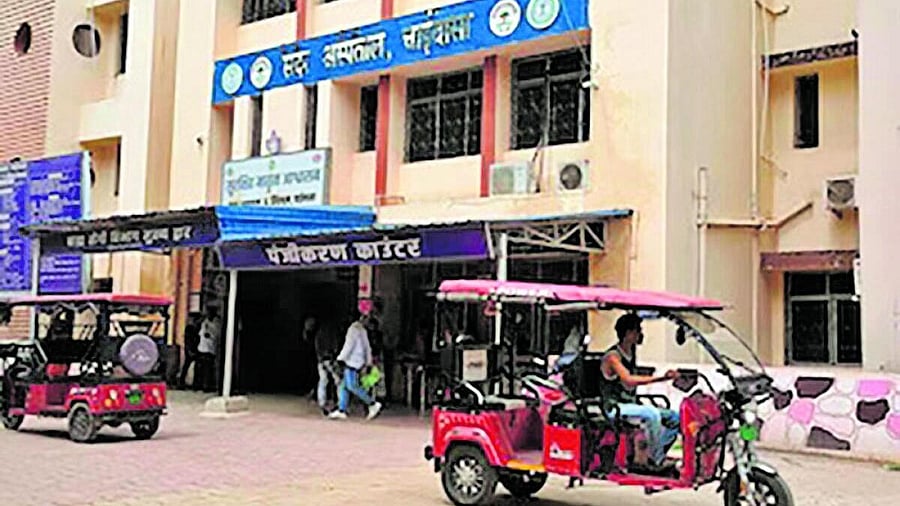
Five cases of HIV infection from blood transfusion were reported from Sadar Hospital in Chaibasa.
Credit: Social media
Ranchi: The public healthcare system in Jharkhand is in the eye of the storm after recent reports of six children getting infected with HIV following transfusion of contaminated blood. The victims, aged between six and ten years, are thalassemia patients who need regular blood transfusion every fortnight.
While five cases were reported from Chaibasa, the sixth one was traced to Koderma. All received blood from the blood banks run by the Sadar Hospital of respective districts. The incident has shed light on the inadequate, inefficient and unscientific management of blood banks by the state's health department.
A few examples are enough to paint the correct picture. The blood bank run by the Red Cross Society in Ranchi has been pulling on without a valid license for the past 18 years! A chaotic situation prevails in Pakur following the closure of the blood bank there, and the Gumla district's Sadar Hospital has no blood bank.
Incidentally, the licences of a majority of blood banks in the state have expired long ago. Though many applied for renewal of their licenses, the matter remained pending at various levels.
Aggravating the situation, the laboratories of these blood banks relied mainly on rapid kit tests, the results of which are often inaccurate. Other standard procedures for testing blood samples — ELISA, chemiluminescence, etc. — were overlooked. Either the equipment was not functional due to technical faults or there was a lack of expertise to operate them.
"During 2021-25, 259 donors gave blood to thalassemia patients in Chaibasa. Our further inquiries revealed that the affected patients had received blood from 44 donors in the past. Four such donors were found HIV-infected," Health Minister Irfan Ansari, also a medical doctor, said, adding that the government would take care of the victims' treatment.
As the issue snowballed into a major political row, Chief Minister Hemant Soren ordered suspension of Chaibasa civil surgeon and medical officer in-charge and dismissal of lab technicians concerned in Chaibasa and Koderma. He also announced a compensation of Rs 2 lakh to each of the victims.
As a knee-jerk reaction, the government also shut down 17 blood banks across the state.
"We are doing our best. Our chief minister too is keeping a vigilant eye. The BJP and its allies are trying to gain political mileage (out of the incident)," Ansari said, referring to the political backlash over the incident.
Additional Chief Secretary (health) Ajay Kumar Singh maintained that sample tests with rapid kits have completely been stopped. Only the standard procedures such as ELISA and chemiluminescence will remain in force. Inspections of all blood banks across the state have been completed, he said.
"We are also trying to find out whether infected needles were used during blood transfusions. Detailed inquiries may take a little more time. Network Address Translation is being given special attention to maintain an accurate database of blood donors," he added.
To smoothly run the blood bank management system, six master trainers have been pressed into service for effective functioning of e-blood cells. Digitalisation of all blood banks and availing of broadband services have caught the attention of officials at the helm of affairs.
A senior official of the Jharkhand State AIDS Control Society maintained that blood banks have been asked to strictly follow the standard operating procedure.
"Our Society is nowhere involved in the latest controversies. On our part we have issued necessary guidelines," the official signed off even as public health advocacy groups have expressed concern over the lack of blood screening facilities in state-run hospitals.
BJP state president and leader of the Opposition in Jharkhand Vidhan Sabha Babulal Marandi termed the incident as a "state-sponsored attempt to kill innocent children". He alleged that CM Soren was now trying to get rid of his responsibilities by fixing a few erring officials, mainly technicians.
"If these children die, who should be held responsible? The incident exposes how insensitive the Hemant Soren government is," he said.
On November 1, Governor Santosh Gangwar expressed strong reservations over the laxity on the part of the official machinery. He stressed that merely penalising the erring officials wouldn't suffice. Concrete measures should be taken to prevent such incidents from repeating in future, he said.
Taking suo motu cognisance of a media report that a seven-year-old boy in Chaibasa had contracted HIV after being receiving infected blood at the Sadar Hospital, a Division Bench of the Jharkhand High Court on October 30 summoned top officials of the health department and asked them to clarify through an affidavit the status of blood donation camps, the demand and availability of blood in various blood banks, etc.
They were also asked to formulate and implement guidelines for the prevention and spread of AIDS.
(The writer is a Ranchi-based journalist)