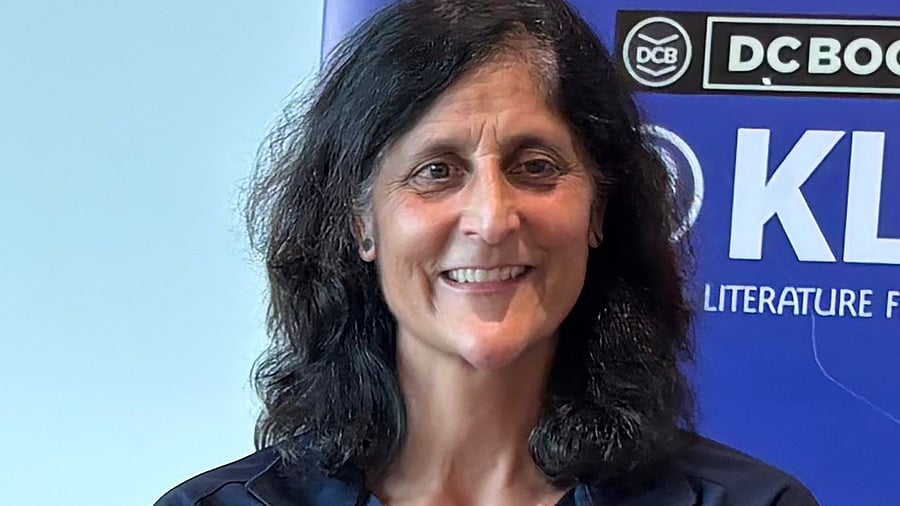
Fresh off the announcement of her retirement from NASA just a day ago, legendary astronaut Sunita Williams touched down at the ninth edition of the Kerala Literature Festival (KLF) on Thursday. In an exclusive interaction with DH, the record-breaking space explorer reflected on her 27-year career, the heartbreaking transition to retirement, and her new-found status as a civilian who just wants to catch up on sleep and spend time with her pets. Excerpts:
l Now that you have retired from NASA, will you be helping India in its human spaceflight programme (Gaganyaan) in any capacity?
I don’t know what I’m going to do next; I don’t have any plans per se. Right now, I just want to relax for a little while and spend some time with my family, my friends, and my dogs. Hopefully, being here and talking to students will help promote STEM in this country. I don’t have any major objectives except to share my story and the story of space exploration.
l What will you miss most about space and the programme?
The view of our planet is incredible, and not having that opportunity again is a little heartbreaking. But really, it is the people. My husband always tells me I am lucky to work with such inventive, smart people who just want to get the job done. I actually retired on December 27, but I have been so busy it doesn’t feel like it yet. Now, it is time to pass the torch to the next generation. I am looking forward to them becoming famous and doing big things.
l Can you take us back to the exact moment you decided you wanted to go to space?
Honestly, I was surprised when I got into the programme. I thought it might have been a clerical error! My background was as a helicopter test pilot; I am operational. I studied engineering, but I never thought it was my forte. However, being a tester and knowing how to ask the right questions while developing spacecraft turned out to be a good fit. I just tried to do my best, and it turned into an amazing opportunity to help build and operate the space station.
l Given the skewed representation of non-binary and queer identities in STEM, how can we ensure more inclusivity in space programmes?
To be honest, that is a question I have never thought about. I have historically held jobs that were for males. My approach has always been to put the “blinders” on and just do the best job possible. I think the best way to open doors for any underrepresented group is to prove you can do the job; then there is no debate. Regarding physical inclusivity, we try to accommodate different sizes in spacesuits, but it is an expensive business, and there are certain height criteria. But if people are the best for the job, I don’t see any roadblocks.
l How did you cope with the uncertainty of your last mission when the stay was extended unexpectedly?
The hardest part was the summer, when we didn’t know if we were going back on our spacecraft or not. We were extra crewmates up there. We were eating a lot of food and using the bathroom a lot. You have to pitch in and do the non-glorious jobs, like fixing meals or stocking supplies, to be part of the team. The most precarious time was when our original spacecraft left to free the docking port and we were waiting for SpaceX Crew-9. We had a plan, but it was a team sport. I felt lucky to get extra time in space.
l What was it like being away from your dogs, and what is your take on the Supreme Court of India’s directives regarding community dogs in public spaces?
My dogs are huge in my life. I lost my Gorby in 2017, but Gunner and Rotor are my little buddies. While I was up there, a cargo craft brought me 3D-printed miniatures of my dogs, which was wonderful. Regarding the legal issues with community dogs, I only read a snippet about it, but I understand the priority of human safety. However, it is partially our fault as humans for creating environments where animals can’t live naturally. From space, you realise every person, animal, and plant lives on this one planet. We all need to give each other a little physical space.