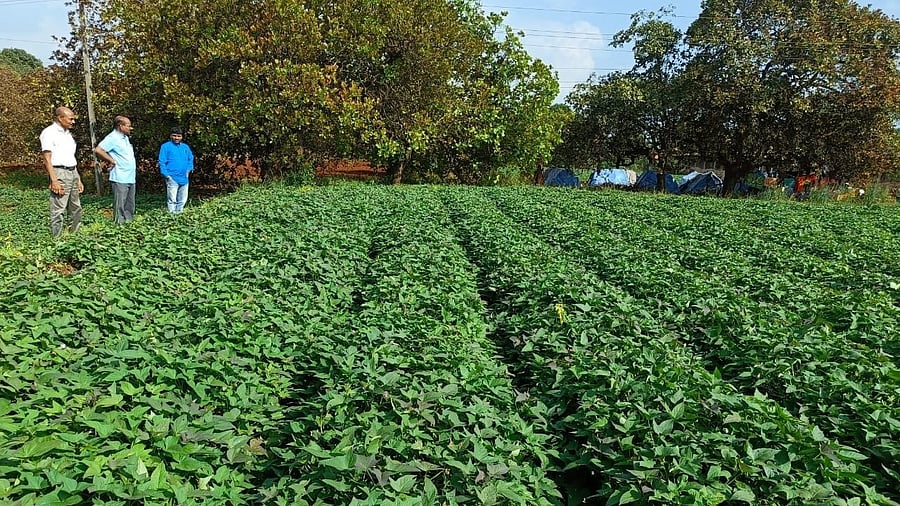
On the fringes of Belagavi and Khanapur taluks, fields that once grew mainly maize, with only small patches of sweet potato for household use, are now transforming into vibrant swathes of the tuber. Farmers are experimenting with striking varieties of sweet potato— orange, cream and deep purple — bringing a fresh and colourful look to the landscape.
Traditionally, sweet potato cultivation in Karnataka was confined to coastal, hilly and forest regions, grown mainly for household consumption or local markets. But with climate variability increasing and water-intensive crops becoming riskier, farmers in Belagavi, Hassan, Mysuru, Kodagu and Kolar are turning to this resilient tuber.
Unlike maize or paddy, sweet potatoes need less water, withstand irregular rainfall and require minimal inputs, making them a smart and sustainable choice.
The shift is evident in the numbers. Karnataka’s sweet potato area has grown from 5,032 hectare in 2018–19 to 8,100 hectare in 2023–24, with production rising from 73,050 tonnes to 1.08 lakh tonnes. Belagavi, the state’s sweet potato hub, alone cultivated the crop on about 7,434 hectares in 2024–25.
For farmers here, the switch brings a predictability that other crops no longer offer. Raju Kamble of Bailur, near Khanapur, recalls uneven yields of older varieties. “With the new lines, the tubers are uniform, harvest is quicker and prices are better,” he says, pointing to lush vines with vibrant foliage.
In Thirthkunde, Belagavi, Balwanth Krishna Naik has moved from the older four-month Malkapuri variety to the quicker Kishan variety. “I use very little fertiliser and almost no pesticide now,” he notes. “Buyers from Delhi, Mumbai, Gujarat, and Kolkata are asking for more every season. The demand is more from outer states as sweet potato is gradually replacing potato in star hotels. Also, they are being increasingly used in making chips, desserts and other dishes.”
This crop expansion is facilitated by All India Coordinated Research Project on Tuber Crops (AICRP TC) centre in Dharwad, Karnataka’s only dedicated tuber research facility. Under the University of Horticultural Sciences (UHS), Bagalkot, and linked to the national network led by the Central Tuber Crops Research Institute in Thiruvananthapuram, the centre evaluates promising varieties and produces planting material suited to Karnataka’s diverse agro-climates. It also trains farmers on crop improvement, pest management, soil health, climate-smart planting and improved varieties, ensuring that scientific advice works on the ground.
Nutrient-rich varieties
Imamsaheb Jatth, principal investigator at the centre, says new varieties such as Bhu Sona, Bhu Krishna and Kishan were developed at the AICRP regional centre in Odisha’s Bhubaneswar and adapted locally. He says with their nutrient-rich colours and high antioxidant content, these varieties are also being incorporated into public nutrition programmes.
In Davangere, for example, the Krishi Vigyan Kendra and Sirigere Taralabalu Mutt are using locally grown sweet potatoes in meals served to nearly 2,000 students.
UHS Director of Research Fakrudin B adds that scaling up cultivation is possible if climate-resilient varieties continue reaching farmers. “Our goal is to recommend lines that improve both farmers’ incomes and consumer nutrition,” he says, adding that the university plans to propose to the state government to include it in mid-day meals.
Apart from sweet potato, the Dharwad centre is also focusing on other tuber crops such as elephant foot yam, tapioca, greater yam, arrowroot, and taro. In addition, the centre collects and conserves minor tuber crop germplasm in the field gene bank and utilises this valuable diversity in further breeding programmes.
With rising cultivation, expanding market demand and strong institutional support, sweet potato, once seen as a marginal crop, is emerging as a sustainable, future-ready option for the state’s farmers.