
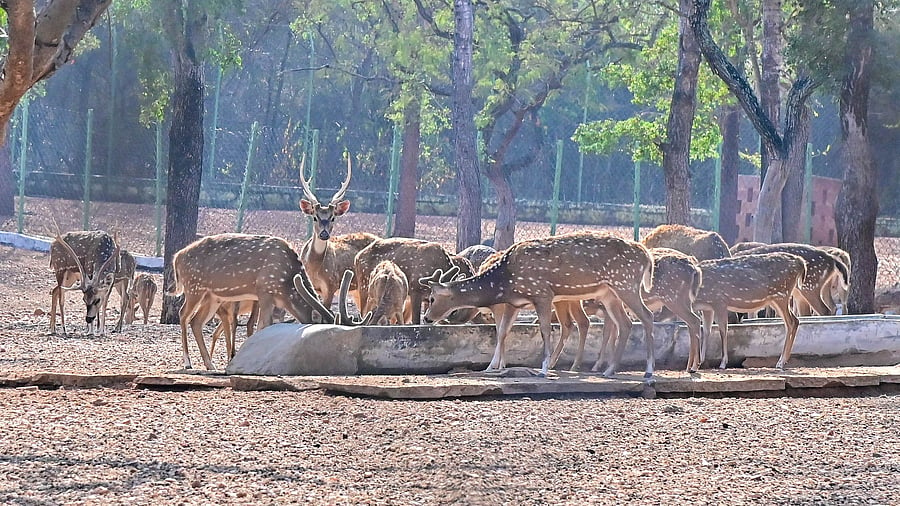
Spotted deer at the Indira Priyadarshini mini zoo at Aangodu near Davangere. DH photo/Satish Badiger
Davangere: Following the death of four spotted deer due to suspected haemorrhagic septicemia at Indira Priyadarshini mini zoo at Aangodu near here in the last four days, treating the remaining 166 deers which may have been infected has turned out to be an uphill task for the forest department.
A team of six members led by wildlife veterinarian Prayag H S is providing treatment to all deer in the zoo.
The treatment is expected to continue for one more week. The dearth of animal keepers (presently only two are serving) and the absence of adequate enclosures are turning out to be impediments for the existing staff.
Deputy conservator of forests Harshavardhan P N told DH, “Haemorrhagic septicemia (HS) is an airborne disease. It is contagious and deadly. So, we are taking all possible measures to ensure that the remaining deer are not infected. Generally, it spreads from infected livestock to other animals. There is a national highway in front of the zoo and a reserve forest behind it. Hence, there is no possibility of the movement of domestic cattle in and around the zoo. So, there is a need to investigate the source of disease outbreak”.
He said, “the situation is under control and the samples of blood and some organs of the deceased deer have been sent to Institute of Animal Health and Veterinary Biologicals in Bengaluru for testing. We expect to receive the report in two to three days.”
“As the number of spotted deer and blackbucks is over 100, identifying symptomatic deer is practically impossible,” Harshavardhan said.
“Above all, deer are highly sensitive animals and we can’t capture them and provide treatment,” he added.
As many as 31 blackbucks died due to a fatal outbreak of haemorrhagic septicaemia at Kittur Rani Chennamma mini zoo in Belagavi recently.
Treatment mode
The zoo staff are mixing medicine with the food given to the deer once in the day. Dry grass is fed to them in the evening.