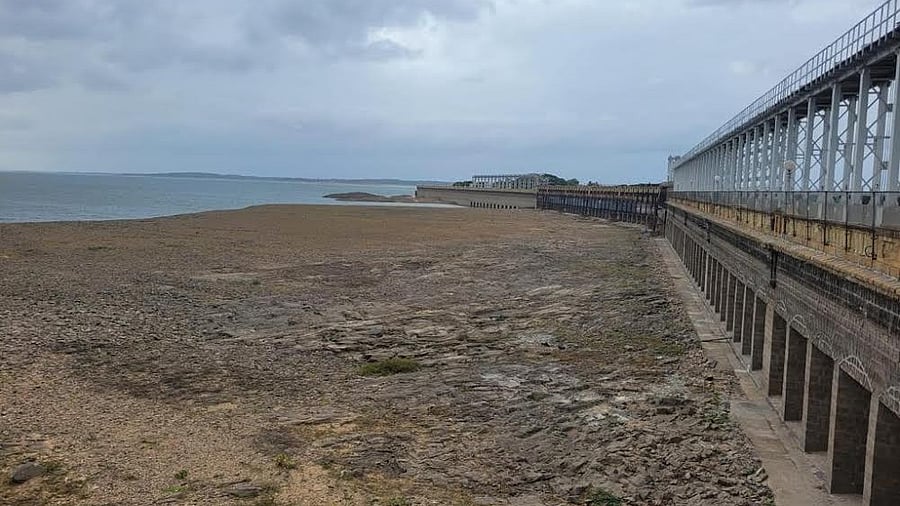
Krishna Raja Sagara (KRS) reservoir.
Credit: DH Photo
Twenty-two reservoirs in Karnataka have only 64.70 per cent of their total water storage capacity, with the "critical situation" prompting authorities to call for judicious use of water and not take up "water-guzzling crops" for cultivation.
As on August 26, dams in Karnataka had 349.53 tmcft of live water (water available for use) as against 584 tmcft total storage capacity. On the same day last year, the live storage stood at 467.76 tmcft. In 2021, the state had 439.60 tmc ft of live water.
According to officials at these reservoirs, there is sufficient water to provide drinking water till the next monsoon and, in some areas, for a single crop in the kharif season. Several farmers in the Cauvery and Krishna basins informed DH that they have been asked not to plan for rabi cultivation.
Water Resources Department Secretary Krishnamurthy B Kulkarni said Karnataka is facing a “critical situation”.
“If we continue to use water judiciously, we may not face a drinking water crisis. However, providing water for irrigation is a big task. The Irrigation Consultation Committees (ICC) of various reservoirs are making efforts to create awareness among farmers to avoid water-guzzling crops even in this season,” he said.
Cauvery basin
Karnataka is divided into two major river basins: Krishna and Cauvery.
Officials say they can manage the water situation (provide water for drinking and cultivation) in the Krishna basin for now. However, the situation is very grim in the Cauvery delta.
The 16 reservoirs in the Krishna basin have nearly 293.86 tmcft of water against their total capacity of 379.51 tmcft, whereas the four major reservoirs in the Cauvery basin have only 50.4 tmcft of their total 73.76 tmcft capacity.
Krishna Raja Sagara (KRS) dam, which is a major lifeline for agriculture in the Old Mysuru region, has only 17.04 tmcft as against its gross storage capacity of 49.45 tmcft. Among the major 10 reservoirs in Karnataka, KRS has the least live storage. Lal Bahadur Shastri Dam at Almatti has the highest live storage currently (105.22 tmcft).
G M Puttaraju, a farmer in Mandya, said officials have informed him that they would not be able to supply water for his standing paddy crop on 13 acres of land. “This is a critical time for transplanting paddy to the main field. However, I am on the verge of losing the crop as there is no water supply,” he said.
A senior officer with the Cauvery Niravari Nigama Limited said the "ongoing dispute with Tamil Nadu is adding additional pressure on the officials against releasing water to Karnataka farmers”.
Zero inflow
In the second half of July, copious rains in Maharashtra ensured sufficient inflows for the 16 reservoirs of Krishna basin that month. However, the inflows into these reservoirs has come down drastically since then. Hidkal, Almatti, Malaprabha and Narayanpur reservoirs have recorded zero inflows.
Basappa Jankar, TB Dam Assistant Executive Engineer, said last year the reservoir was full by July 15.
“We were expecting 175 tmc ft of water by the end of this monsoon. So far, we have stored only 71.46 tmc ft of water. As a result, we are unable to release water for cultivation," he said.