
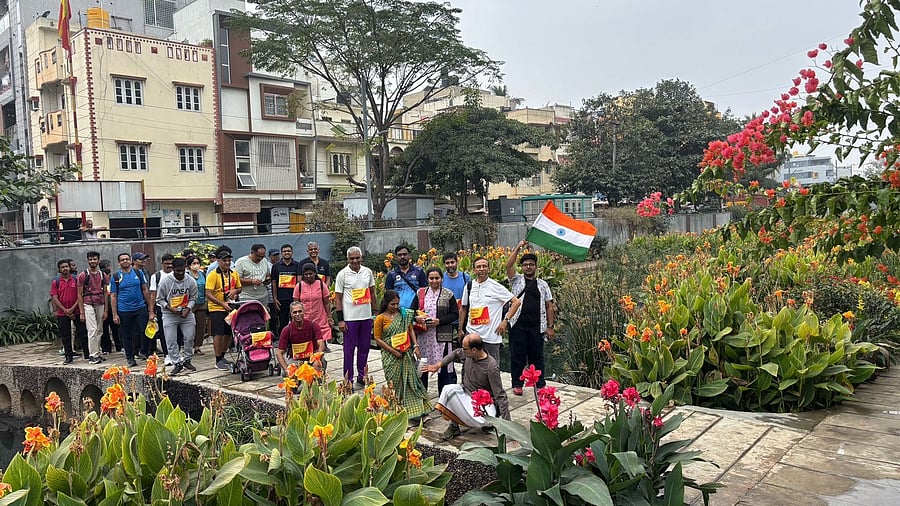
Participants of the 26-km walk from RV Road, Jayanagar,to Orion Mall, Rajajinagar, held on New Year’s Day.
Credit: DH photo
Bengaluru: More than 200 people walked on a path built inside a stormwater drain along a 26-km stretch connecting the city's south to the north.
A video of the walk, on New Year's Day, has been widely shared on social media.
The Bangalore Walks initiative was led by Arun Pai, Coordinator, Walkaluru, a joint initiative of citizens and the Greater Bengaluru Authority (GBA), which created the path.
The walk from RV Road, Jayanagar, to Orion Mall, Rajajinagar, aimed to focus on connected and walkable footpaths to show that the city has good walkways.
However, the main focus of this initiative was a 2-km stretch inside a 10-km drain from Shanthinagar to Hosur Road leading to Langford Road.
Chief Secretary Shalini Rajneesh, GBA Chief Commissioner M Maheshwar Rao and the commissioners of three city municipal corporations also joined the walk.
"We walked from sunrise to sunset, but this drain became the attention of the walk. It is an incredibly ambitious project and there is no project like this in the country," Pai said. He was referring to the K100 Citizen's Waterway Project to rejuvenate the stormwater drain.
Civic authorities have desilted the drain by removing more than two truckloads of silt and planted trees along the way to stop it from flooding. The plants have also beautified the path.
GBA Chief Maheshwar Rao said more such projects were planned across Bengaluru. "We are coordinating with the BWSSB to allow the flow of treated water into the drain as there is still a mix of sewage water in it. Once this is cleared, we will implement it in other drains as well," he told DH.
Prasad Paramashivappa, one of the participants, praised the efforts of the authorities. "Rajakaluves (stormwater drains) have disappeared in Bengaluru due to encroachments, but to see this project makes us happy,” he said. “Though there are some issues like dampness and overflowing, largely, the place is great."
Fix first, use later
Naresh Narasimhan, the man behind the K100 Citizen’s Waterway Project, said the work began with desilting and restoring the drain’s hydraulic capacity, followed by intercepting and diverting sewage entering the system.
“At its peak, nearly 135 MLD of sewage flowed into the drain. This has been reduced to about 5 MLD through targeted interception and treatment,” he said.
“Only after the waterway began functioning again as a stormwater system did we add public elements such as continuous walking paths, safe crossings, native landscaping and lighting. The idea was to treat the stormwater drain as part of the everyday public realm,” he added.