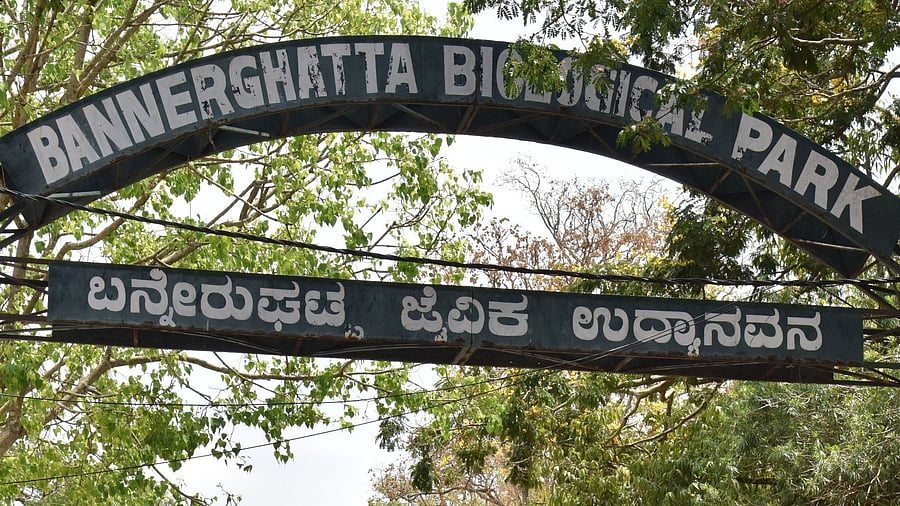
The Bannerghatta National Park.
Credit: DH Photo
Bengaluru: Nearly six years after the buffer zone of Bannerghatta National Park (BNP) was shrunk by over 100 sq km, allowing largescale commercial activities to tear into the protective ring, activists have now moved the Supreme Court for preventing further damage.
The BNP is spread over 260.51 sqkm in the southern border of Bengaluru and is part of the 1400 sqkm wildlife habitat and recognised as the terminal point of the Mysore Elephant Reserve besides playing host to tigers, leopards, dhols, sloth bear and other animals.
In 2016, the Ministry of Environment, Forests and Climate Change (MoEF&CC) issued a draft eco sensitive zone (ESZ) notification, providing a buffer area that measured between 100 metres to 4.5 km from the BNP boundary. However, the state government revised the (draft) ESZ in May 2018 reducing the maximum width of the buffer to a mere 1 km, with the total area of the ESZ coming down from 268.8 sq km to 168.84 sq km. This was notified as the final ESZ in 2020.
Kiran Urs, a software engineer who analysed the changes on the edge of BNP through Google Earth historical imagery, said the northernmost part of Bannerghatta is facing an existential threat due to the blunders made in the ESZ boundary and the subsequent development activities.
He pointed out that the reduced boundary has effectively dropped several rocky outcrops, revenue lands and agricultural fields in key areas which has exposed the BNP to activities that affect wildlife. He cited the developments on the outskirts of Ragihalli, Sollepuradoddi and Guddegowdanadoddi to highlight the problems. "On the other hand, resorts and other commercial activities are mushrooming in the area. On the other hand, the revenue and agricultural land is fast turning into new layouts, posing a direct threat to the BNP's wildlife," he said.
Meanwhile, the proposed Satellite Township Ring Road (Phase II) cutting through the narrowest part of BNP is seen as a final blow to the park. "The National Highway Authority of India promises to build a flyover with sound barriers. However, a personal visit to a similar road in Pench tiger reserve in Madhya Pradesh showed that sound barriers do not work," Urs said.
Speculative investment
Somashekhar T, a farmer from Kadujakkkanahalli, said the government has emerged as the biggest violator in the buffer zone. He said starting 2013, officials had been trying to acquire land from unwilling villagers for a project, which later turned out to be the Suryanagar Layout developed by the Karnataka Housing Board. "This area was once part of the ESZ. They are now developing phase 5 by razing entire hillocks and removing the greenery. Even though nobody has built houses in the previous phases, there is no end to the creation of new layouts," he said.
Somashekhar is fighting against the government's move to acquire his 4 acre land. Shivakumar, another farmer, is trying to save his 18 acre from becoming a dry layout. "I want to remain a farmer rather than selling my land for a project which only fuels investments," he said.
Somashekhar said the Anekal belt of farm fields was known as ragi bowl. "An entire history is being wiped out," he said.
CEC to assess BNP buffer
In May 2025, KB Belliappa and others filed a petition before the Supreme Court to highlight the damage the reduced buffer zone has caused. Members of the Central Empowered Committee are scheduled to visit the site on January 2 and 3 to assess the situation.