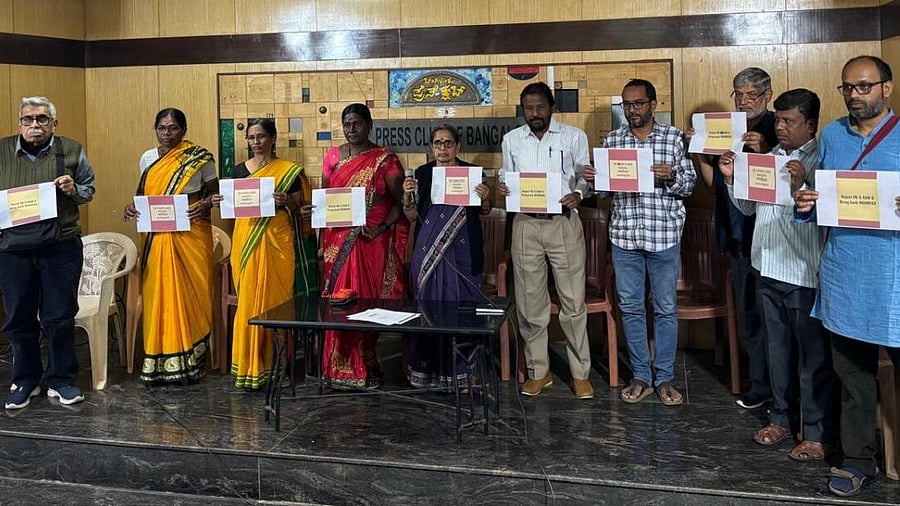
NREGA activists held pamphlets over proposed ‘VB-GRAMG’ act in Bengaluru.
Credit: Ashwin B M
Bengaluru: Rural workers and activists on Friday raised a banner of revolt against the Union Government’s decision to replace the Mahatma Gandhi National Rural Employment Guarantee Act (MGNREGA) with the Viksit Bharat-Guarantee for Rozgar and Ajeevika Mission (Gramin) (VB-GRAMG) Act, 2025.
Speaking at a press conference organised by the NREGA Sangharsh Morcha, experts and worker representatives termed the move a "death knell" for the rights-based framework of rural employment. They alleged the new Act, passed within 72 hours without public consultation, shifts the scheme from a demand-driven legal right to a "command-driven" central programme.
Fiscal burden on the state
The financial implications for Karnataka are particularly stark. Economist Vinod Vyasulu pointed out that under the new 60:40 cost-sharing ratio, the state’s financial burden will quadruple.
In the 2024-25 fiscal year, the Karnataka government spent Rs 573 crore under MGNREGA. To provide the same 13.12 crore persondays under the VB-GRAMG Act, the state would now have to shell out Rs 2,729 crore. "If the state attempts to meet the promised 125 days of work, the cost would balloon to Rs 7,573 crore, severely crippling health and welfare allocations," Vyasulu warned.
Theft of dignity
Activists highlighted several "regressive" provisions, including a 60-day 'blackout period' during peak agricultural seasons. "This pits workers against farmers and strips marginalized communities of their bargaining power," said Sharada Gopal of Jagruta Mahila Okkutta.
Advocate Clifton D’Rozario argued that the Act violates the 2018 Supreme Court order in the Swaraj Abhiyan case by absolving the Centre of liability for wage delays. Further, the shift toward "Viksit Gram Panchayat Plans" aligned with PM Gati Shakti was criticized as an assault on the 73rd Constitutional Amendment, turning local bodies into "labour suppliers for central contractors."
Nikhil Dey, a veteran activist, called the headline promise of 125 days a "scam," noting that the Centre currently struggles to provide even 50 days. He highlighted that the new Act mandates biometric authentication and "geospatial planning," which activists fear will exclude the poorest workers whose fingerprints are often worn from manual labour.
The activists demanded the immediate restoration of MGNREGA, asserting that the new law "thefts the dignity" of Dalit and Adivasi workers.