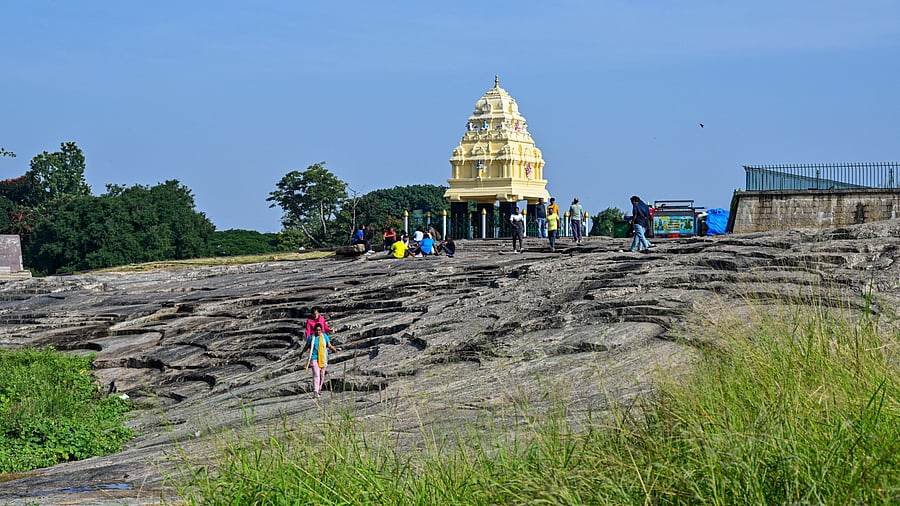
The Peninsular Gneiss at the Lalbagh Botanical Garden in Bengaluru.
Credit: DH Photo
In the vibrant heart of Bengaluru, a city famous for its silicon chips and software code, stands a monument to a far deeper past: a 3.4-billion-year-old rock. It predates the digital age, the city’s temples and even life itself. Rising from the greenery of Lalbagh Botanical Garden, this sprawling, humped mass of grey stone is the legendary Peninsular Gneiss (pronounced Peninsular “nice”). For morning joggers and tourists, it is a scenic viewpoint. But to a geologist, it is a piece of the earth’s earliest crust — older than the Himalayas, the dinosaurs and even atmospheric oxygen.
The Lalbagh Rock is estimated to be between 3.0 and 3.4 billion years old. Considering the earth is about 4.5 billion years old, this silent giant has existed for nearly three-quarters of our planet’s history. It formed during the Archean Eon, when the earth was a hostile world with a toxic atmosphere and raging volcanic activity.
The gneiss in Bengaluru is one of the world’s most accessible windows into deep time.
Credit: DH PHOTO/PUSHKAR V
Geologists determine the age of such ancient rocks using microscopic zircon crystals — durable time capsules that hold reliable radiometric signatures. In 1975, recognising its scientific value, the Geological Survey of India declared the Lalbagh outcrop a National Geological Monument. Unlike other ancient formations such as the Acasta Gneiss in Canada or the Jack Hills zircons in Australia, this one sits in the middle of a bustling metropolitan city, making it one of the world’s most accessible windows into deep time.
Visitors often mistake the rock for granite but its story is far more dramatic. Granite forms from slowly cooling magma whereas gneiss is a metamorphic rock, one that has been transformed under immense pressure and heat.
Billions of years ago, this rock lay buried kilometres deep and endured temperatures above 600°C. Geologists describe its transformation using a “dough-kneading” analogy: light minerals like quartz and darker ones like mica were stretched, squeezed, folded and baked, forming the parallel layers we see today. Stand close and you can spot these gneissic bands — swirls of black and white that freeze the earth’s early violence in stone.
While the rock was changing internally, the land beneath Bengaluru was travelling across the planet. Today the city lies at about 13° North. But around 300 million years ago, this chunk of continental crust was part of the supercontinent Gondwana, positioned near 70° South, close to the Antarctic Circle.
Through the slow, relentless motion of tectonic plates, this ancient landmass drifted northward over several thousand kilometres, eventually colliding with Asia and contributing to the rise of the Himalayas. This means the rock in Lalbagh has travelled farther than most of us ever will — crossing the entire Southern Hemisphere to reach its present home.
Layers of human history
The rock’s story is not only geological. It has also been a silent witness to human life for thousands of years. In 1932, excavations near the stone quarries east of the outcrop uncovered prehistoric burial sites. Among the finds were large pottery urns with distinctive “elephantine legs” — bulbous, rounded projections at the base of the vessels — pointing to a unique local burial practice that flourished in the shadow of this ancient hillock.
The story continues into medieval times. At the base of the hill, near the western approach, stands a 15th–16th century Veeramasti hero-stone. Unlike the warrior Veeragallu, a Veeramasti memorial commemorates a solemn, voluntary act in which a wife chose to end her life after her husband’s death. Its presence shows that the rock remained culturally significant across centuries, serving as a backdrop not only to prehistoric communities but also to medieval social rituals.
The 3.4-billion-year-old Peninsular Gneiss or Lalbagh Rock at Lalbagh Botanical Garden in Bengaluru.
Credit: DH PHOTO/PUSHKAR V
Fragile ecosystem
Despite its appearance as a massive boulder, the Lalbagh rock supports a fragile ecosystem. Fine crevices trap soil, allowing hardy grasses, mosses and rare lichens to grow. The slopes host the colourful Peninsular rock agama, a lizard that blends perfectly into the grey gneiss. Lichens on the rock also act as natural indicators of air quality.
Unfortunately, this ecosystem is easily damaged. Graffiti chemically etches the ancient surface, and plastic waste disrupts micro-habitats that took centuries to form.
The Peninsular Gneiss of Lalbagh is truly Bengaluru’s eternal foundation. In a city that changes every day, this ancient rock remains constant, a reminder of nature’s resilience and the profound depths of earth’s history.
The 3.4-billion-year-old Peninsular Gneiss or Lalbagh Rock at Lalbagh Botanical Garden in Bengaluru.
Credit: DH PHOTO/PUSHKAR V
As citizens, protecting this National Geological Monument is our responsibility. When we climb it, sit on it or watch the city skyline from its summit, we are standing on billions of years of memory. With care and respect, this ancient witness will continue telling Bengaluru’s story for generations to come.
(The author is Honorary Project Director, The Mythic Society, Bengaluru)