
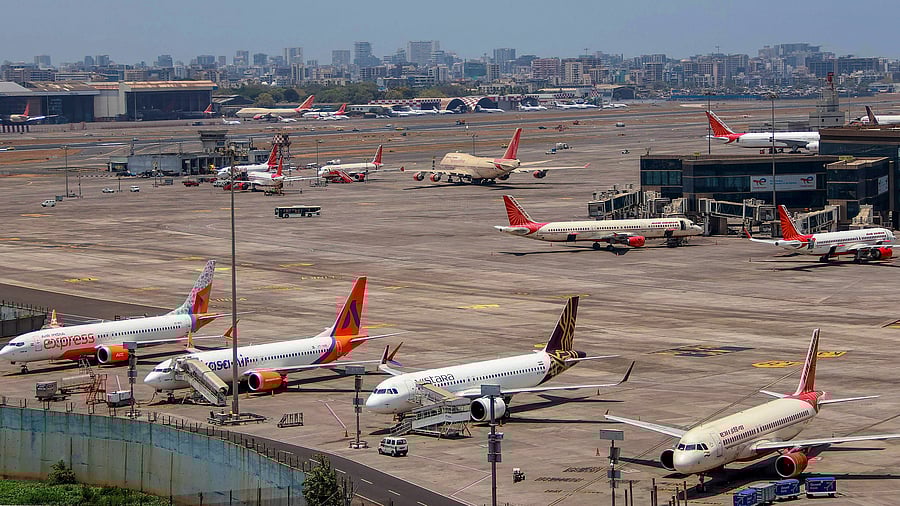
Air India and other planes parked at an airport.
Credit: PTI File Photo
India must exploit the current geopolitical shift for the aviation industry to grow rapidly, aviation industry experts said at the 8th International Conference on the Future of Aviation and Aerospace (FoAA).
The conference was hosted by IIM Bangalore in partnership with TBS Education, France. The agenda encompassed India’s increasing role in global supply chains, the potential of Make in India, and emerging innovations such as EVtol, drones, and AI-powered aviation systems.
At one of the panel discussions, Director General of Aerospace India Association Srinivasan Dwarakanath brought critical attention to India’s readiness not only to participate in but to lead the global aerospace value chain. "India should aim to move from less than 1-10% of the global supply chain in aviation," he stated.
Panellists CEO of JJG Aero Anuj Jhunjhunwala, Joint MD of Sansera Engineering FR Singhvi, and SVP and CTO of Cyient Kaushal Jadia stressed the importance of exploiting current opportunities due to geopolitical shifts after the tariff and trade war between the US and China.
Singhvi urged Indian firms to shed the fear of failure and invest in R&D. "We must move from the colonial throwback of being obedient followers to fearless innovators," he opined.
The panel discussion on 'Exploring market potential for aviation' featured Director of Air India Aviation Academy, Sunil Bhaskaran, and Conference Chair Prof Shainesh G, IIMB.
"Indian aviation is at an inflection point. The aviation ecosystem is seeing tremendous growth with an order book of over 1700 aircraft. In such a scenario, we need trained manpower; 30,000 to 35,000 pilots in the next five years. We need to produce skilled manpower not just for India but also for the developed world as well,” Bhaskaran said.
He also pointed out the sustainability challenges involved in aviation. "Fossil fuels will not be replaced till 2050 possibly; Sustainable Aviation Fuel (SAF) is four to five times the cost of fossil fuels but India has huge potential in terms of the amount of solid waste management. By 2027, all flights might be mandated to use 1%-2% SAF for all flights," he remarked.
Bhaskaran also remarked that the upcoming second airports in Mumbai and Delhi, and the proposal for a second airport in Bengaluru, were positive signs for the aviation industry.
Other panels explored topics such as Make in India- The achievements of Indian companies, opportunities and challenges in the EVtol and drone market, and the future of AI and analytics in aviation and aerospace.