
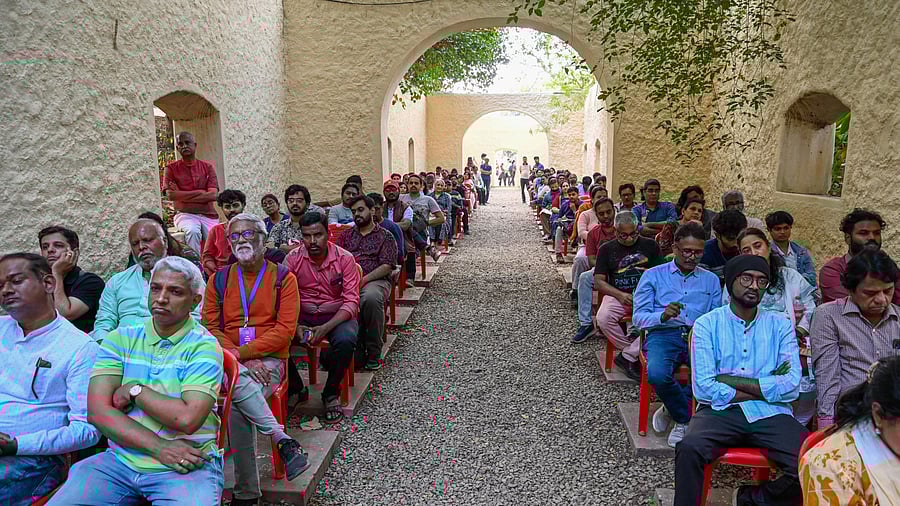
A section of the audience on Day One of the Bangalore Literature Festival on Saturday.
Credit: DH Photo/M S Manjunath
The 14th Bangalore Literature Festival kicked off on Saturday, drawing roughly 15,000 people to panel discussions on topics ranging from male insecurities and artificial intelligence to language imposition.
Some found the new venue, Freedom Park (Bengaluru’s former central jail), with its pale-yellow high walls, central watchtower and lush greenery against a bright blue sky, a fitting backdrop.
The festival, however, was hit by the IndiGo crisis, causing three panels on the inaugural day to be cancelled, while three others proceeded with fewer speakers. About 20 of the 285 authors slated for two-day of the festival will not be attending. Most sessions held drew packed audiences and frequent applause.
In the ‘Should a Country Speak a Single Language?’ panel, cultural activist G N Devy and ‘Heart Lamp’ translator Deepa Bhasthi advocated for multilingualism.
Deepa said speaking multiple languages expands one’s ability to express and understand the world, while Devy warned, “Pushing a country toward monolingualism is the first step toward becoming fascist”.
In ‘What Do Men Fear?’, panelists examined how patriarchal expectations of being “protector, provider, and procreator” weigh on men, and the need for spaces where they can reflect and be vulnerable.
Kartikeyan V said men are often trapped in dilemmas like “belonging versus shame” and “self versus family”.
Sonora Jha struck a chord with the audience, citing the famous quote: “Men are afraid that women will laugh at them. Women are afraid that men will kill them.”
Dilip Pattubala added context, noting that men’s self-worth is closely tied to their jobs, but the job market has been precarious in the last five years.
Boys are dropping out of school to provide for families, he illustrated.
Clare Mackintosh, British police officer-turned-author, had the audience in splits in her session ‘Killers on the Loose’. She said she is always wondering “how to murder someone”.
An audience member took the humour further, saying, “I lost five high-end bicycles in Britain and never got them back. Maybe the British police were busy writing crime fiction.”
Clare explained that piecing together a compelling narrative is central to both policing and writing. She doesn’t judge her characters, just as she wouldn’t judge real people. Her early days on the force taught her that humans, under extreme circumstances, are capable of doing “terrible things”. Crime fiction, thus, allows readers to make sense of “this chaotic world” and discover their own “happily ever after”.
Elsewhere on campus, census enumerators highlighted how their work reveals the real lives behind statistics, often challenging common stereotypes.
Haseena Malnad pointed out that Muslim women, widely assumed to marry early, are in fact highly ambitious.
Children enjoyed enactments of Tenali Rama tales, book lovers queued to get their favourite authors’ books signed and others waited their turn for live caricatures.
In a session at the Left Barrack, featuring Unboxing BLR CEO Malini Goyal and her Kannada translator Pratibha Nandakumar, the former shared insights about the writing of her book ‘Unboxing Bengaluru: The City of New Beginnings’.
The not-for-profit is working on numerous projects — from setting up a startup tech museum documenting Bengaluru’s and India’s startup ecosystem and growth in the tech world to gathering crucial data about the city. “We hope to improve the city’s soft infrastructure,” Malini said.
The final session at the Left Barrack had a dramatic finish. Former spymaster Vikram Sood arrived just seven minutes before his session on the current world order was scheduled to end, yet managed to summarise the key arguments of his new book. He spoke of the decline of the US, the resurgence of Russia, and the reassertion of China, and warned that “If India misses the bus now, we will not be able to get up for 300 years”.
Before his arrival, moderator Nitin Pai engaged the audience with trivia, revealing that Kurt Tank, who had designed aircraft for the Nazis during World War 2, was invited by India to lead the development of its first indigenous jet fighter, the HAL HF-24 Marut, at HAL Bengaluru.