
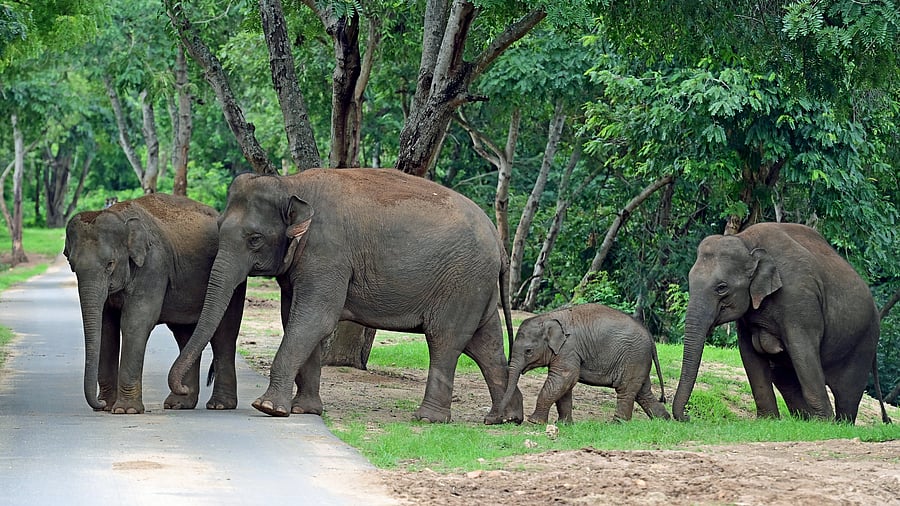
Bannerghatta: CEC flags eco sensitive zone violation, suggests restoration
Credit: DH photo
Bengaluru: In a big blow to the Karnataka government, the Central Empowered Committee (CEC) has recommended withdrawal of the 2020 government notification that diluted the eco sensitive zone (ESZ) of the Bannerghatta National Park and restoration of the wider ESZ as provided in the draft notification of 2016 within six months.
The CEC report comes in the wake of a petition by KB Belliappa and others challenging the reduction of the ESZ around the boundary of Bannerghatta National Park (BNP).
The petitioners noted that the ESZ in 2017 was proposed at 100 metre to 4.5 km from the boundary of the BNP. This was cut to 100 metre-1 km as per the 2020 notification. As a result, the total area under ESZ came down from 268.96 sq km to 168.84 sq km. This effectively removed protection to about 100 sq km of the buffer zone.
The dilution led to large-scale commercialisation of land, resulting in mushrooming of resorts and unchecked stone mining just outside the ESZ. Farmers have said they were pressured to sell their lands for layouts.
The report said the BNP, together with three wildlife sanctuaries in Karnataka and Tamil Nadu, forms a contiguous forest complex of about 3,000 sq km. It harbours 100 elephants seasonally and has three elephant corridors connecting Karadikkal-Madeshwara corridor, Tali-Bilikal corridor and Bilikal-Jowlagiri corridor. The 2011 guidelines of the MoEF are clear that revenue areas should be part of ESZ if they are part of the wildlife corridors.
The CEC further noted that ESZ reduction was taken by a Cabinet sub-committee rather than the expert committee, in violation of the guidelines. It said the MoEF&CC needs to “withdraw” the ESZ notification.
“The original ESZ extent of 268.96 sq km as proposed in the 2016 draft notification shall be fully restored,” it said, adding that the “entire exercise” to renotify the ESZ shall be completed in six months.
It said the identified elephant corridors and ecologically important patches within the Bannerghatta landscape cannot be curtailed merely on the ground of proximity to urban or peri-urban development, as such curtailment would irreversibly disrupt habitat continuity and defeat the very object of ESZ framework.
Environmentalist Kiran Urs said the government’s failure to follow the ESZ guidelines of 2011 has resulted in damage to the sensitive area. “The government should assess the damage that has happened within the 4.5 km buffer zone. The entire landscape needs to be restored to prevent further damage and wildlife conflicts,” he said.