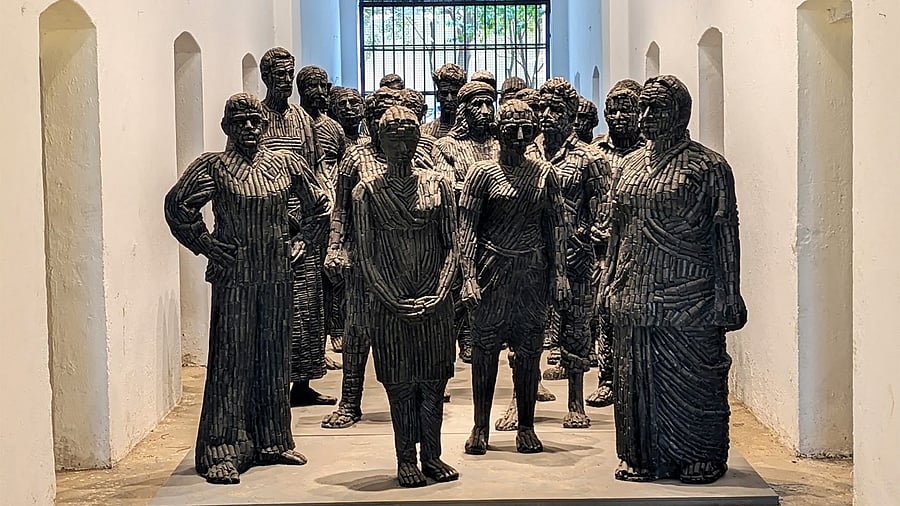
Shantamani's 'Silent Warrior'.
Credit: Giridhar Khasnis
This winter, Bengaluru bustled with a lively calendar of festivals — literary, artistic, and cultural. The season opened with several literature events, including the Samajamukhi Sahitya Sammelana on November 8–9, 2025, at the Bharat Scouts and Guides Headquarters, followed by the Bangalore Literature Festival (December 6–7 /Freedom Park). The city then witnessed the 23rd edition of Chitra Santhe on January 4, 2026, organised by the Karnataka Chitrakala Parishath. It was followed by BLR Hubba, an expansive arts and culture festival from January 16 to 25. The 17th Bengaluru International Film Festival (BIFFes 2026) will continue until February 6.
Touted as the city’s ‘festival of festivals,’ BLR Hubba brought together an array of events that included dance, music, theatre, visual art, and food under one umbrella. Each sub-festival, guided by a separate curator, resulted in an extensive programme that sought to reflect the city’s cultural tapestry. Kala Hubba, the visual arts component, unfolded primarily in public spaces, most notably Freedom Park, a former jail now reimagined as a site for civic and artistic engagement. The choice of location foregrounded the relationship between art, architecture, and public memory.
Curated by Kamini Sawhney, Kala Hubba centred on the notion of freedom and its increasingly fragile nature in contemporary life and times. The chosen artists employed sculpture, textiles, new media, film, and printmaking to explore the concept of 'freedom' from multiple perspectives: freedom from marginalisation and gender discrimination, freedom of speech, and freedom of the body and of the mind.
Among the arresting installations at Freedom Park was Shantamani Muddiah’s Silent Warrior. The charcoal and resin sculptures paid homage to the silent, essential, but often-invisible contributors who sustain communities that shape our daily lives. Installed at the end of a narrow corridor, the dark yet striking pieces invited viewers to pause, reflect and engage with their sombre presence.
Addressing the concepts of comfort, vulnerability, and urban waste, Archana Hande’s Sweet Dreams @ Barrack E displayed 100 security blankets and bedsheets stitched from rejected fabric sourced from Bengaluru and other metros. In a nearby barrack, Mahima Verma’s Mapping Discomfort employed natural materials — black-painted stones symbolising fractured memories of incarceration, alongside living plants that implied renewal and cyclical time. Praneet Soi’s Astatic Garden, originally created for the Kochi Biennale (2016–17), featured coir sculptures produced in collaboration with a Kerala-based factory, and showed suspended moments of human motion.
Among the video works, Swagata Bhattacharyya’s Roadscene (2023) stood out for its restraint and clarity. Set against the backdrop of the year-long farmers’ protest at the Delhi border, the silent film evoked a tense landscape while quietly foregrounding endurance and collective resistance. In contrast, Phytoplankton World: The Unseen Heroes of Marine Life offered an immersive, educational experience to both young and mature audiences, blending playfulness with ecological awareness. Several other video installations were distributed across small cubicles within the site.
Animated patterns
At the Bangalore International Centre, Kala Hubba presented a cluster of works that included Janhavi Khemka’s Letter to My Mother, in which animated patterns inspired by lip-reading explored intimacy and communication. Ravi Kumar Kashi’s Holding Pattern was a tactile exploration of daphne and cotton fibres conveying nuances of our emotions, while Shradha Kochhar’s Vanishing Relics of Safeguarding featured suspended and hand-spun kala cotton forms that alluded to labour, care, and disappearance. In Harshit Agrawal’s Ritual Robots, a robotic arm replaced the priest who performs the traditional havan or homa.
While appreciating the ambition and energy behind Kala Hubba, the visitor found the artworks to be few and far between in the broader context of BLR Hubba. While several works were visually compelling, not all appeared to engage directly with the stated curatorial premise. A stronger presence of Bengaluru-based artists might have lent greater immediacy to the exhibition, allowing for more nuanced engagements with the city’s social, political and everyday realities. Attendance, too, seemed limited: on a weekday afternoon, only a handful of visitors were seen at both Freedom Park and the Bangalore International Centre — raising questions about visibility, outreach, and the challenges of sustaining public engagement with contemporary art/life in the city.