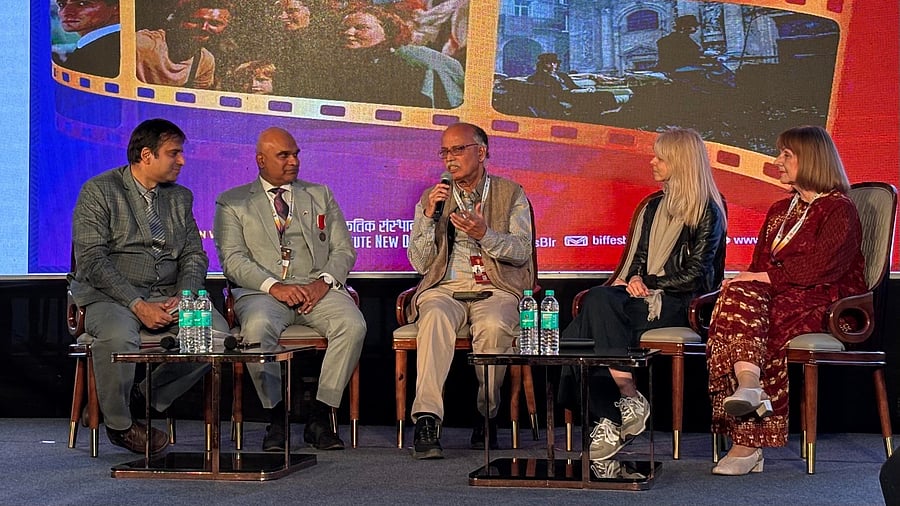
A panel discussion on the enduring legacy of Polish filmmaker Andrzej Wajda titled 'Polish Cinema and the Andrzej Wajda Legacy: Art, History, Cinema, Identity' was organised as part of the 17th Bengaluru International Film Festival on Friday.
Credit: DH Photo
Bengaluru: The 17th Bengaluru International Film Festival (BIFFes) hosted a panel discussion on Friday, focusing on the enduring legacy of Polish filmmaker Andrzej Wajda.
Titled ‘Polish Cinema and the Andrzej Wajda Legacy: Art, History, Cinema, Identity’, the session explored how Wajda’s visual storytelling transcended national borders to remain a beacon for filmmakers today.
The panel featured Malgorzata Wejsis-Golebiak, director of the Polish Institute in New Delhi, Joanna Lapinska, artistic director of the Gdynia Film Festival and N Vidyashankar, artistic director of BIFFes. The discussion was organised as the Polish Senate officially designated 2026 as the ‘Year of Andrzej Wajda’ to mark his centenary.
A central theme was Wajda’s mastery over imagery as a tool against censorship. Vidyashankar noted that while state censors in communist-era Poland scrutinised words, Wajda used cinematic devices and metaphors to communicate the “soul of the community.”
“Wajda taught us that images can speak when words are silenced,” he observed. His war trilogy, culminating in the iconic Ashes and Diamonds, was hailed as a definitive portrayal of a “lost generation,” using a modern aesthetic that influenced global greats from Scorsese to India’s own masters.
Joanna Lapinska highlighted the evolving landscape of Polish cinema, noting a shift towards young, expressive voices while maintaining Wajda’s commitment to freedom.
Malgorzata Wejsis-Golebiak emphasised the importance of Indo-Polish collaboration, viewing cinema as a “common platform” for shared human emotions. The discussion also touched upon the upcoming Film City in Mysuru, with panellists expressing hope that the ‘Polish School’ of filmmaking would inspire the next generation of Karnataka’s cinematic talent. As BIFF screens a retrospective of Wajda’s classics, including Kanal and Man of Marble, the panel concluded that his work is not merely a historical record but a living lesson in artistic courage.