
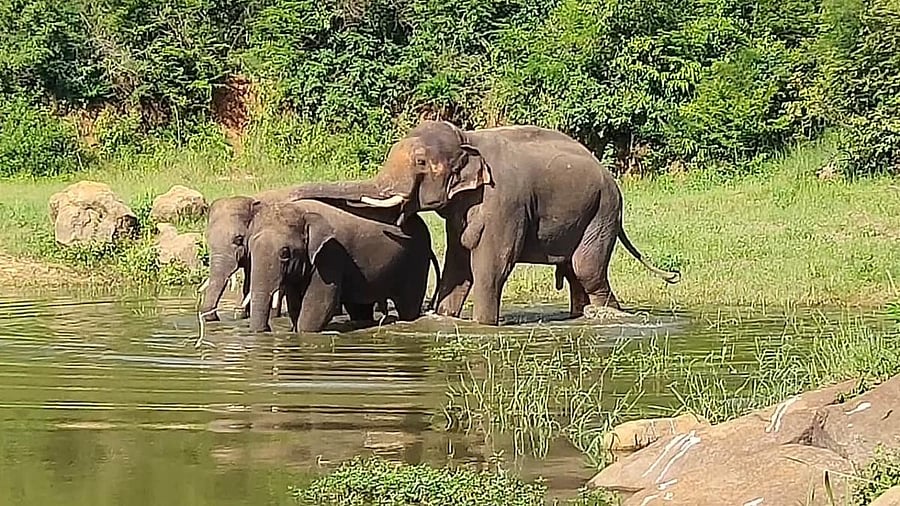
Bannerghatta, home to three elephant corridors, was given an eco-sensitive zone of 100 metres to 4.5 km from the boundary national park in the draft notification published in 2016. However, the cabinet sub-committee unilaterally reduced the same to 100 metres to 1 km.
Credit: DH File Photo
Bengaluru: The dilution of the eco-sensitive zone (ESZ) of Bannerghatta National Park (BNP) was not only against the rules but also impacted the three elephant corridors, the report of the Central Empowered Committee (CEC) has said.
The Guidelines for Declaration ESZ, issued by the Ministry of Environment, Forests and Climate Change (MoEF&CC) in February 2011, require the state government to include within ESZ wildlife sensitive corridors, landscape connectivity areas and other ecologically important patches.
Bannerghatta, home to three elephant corridors and a seasonal host to hundreds of elephants, was given an ESZ of 100 metres to 4.5 km from the boundary national park in the draft notification published in 2016. However, the cabinet sub-committee unilaterally reduced the same to 100 metres to 1 km.
The Karadikkal-Madeshwara Corridor, which provides a crucial passage for elephants moving from BNP to forests in Hosur, Tamil Nadu, has three types of disturbances: stone quarries, Anekal-Harohalli state highway traffic and resorts being developed on the southern boundary of the corridor, which is still active.
The Thally-Bilikal corridor in the Harohalli range, which supports regular movement of 100-200 elephants between the BNP and the North Cauvery Wildlife Sanctuary in Tamil Nadu, already has revenue lands creating a 300-metre gap in the connectivity. Ironically, an elephant-proof trench has been formed about 3 km in the Thally Reserved Forest and 3 km in the Bannerghatta National Park within the corridor area.
Apart from this, the corridor faces a threat from three roads (Thally-Maralavadi road, Elavanthe-Hosadoddi road and Therbidi-Kadusivanapalli) and two 765 KV transmission lines.
The Bilikal-Jawalagiri Corridor has two roads (Belalam-Kadusivanapalli and Elavanthe-Kadukempathalli), which affect the movement of 200 elephants between BNP and Jawalagiri forest in a different part of North Cauvery Wildlife Sanctuary.
To a question, Forest, Ecology and Environment Minister Eshwar Khandre said steps would be taken to restore elephant corridors without affecting the people.
"We aim to prevent man-animal conflict. We want to safeguard the interests of both humans and wildlife, he said.