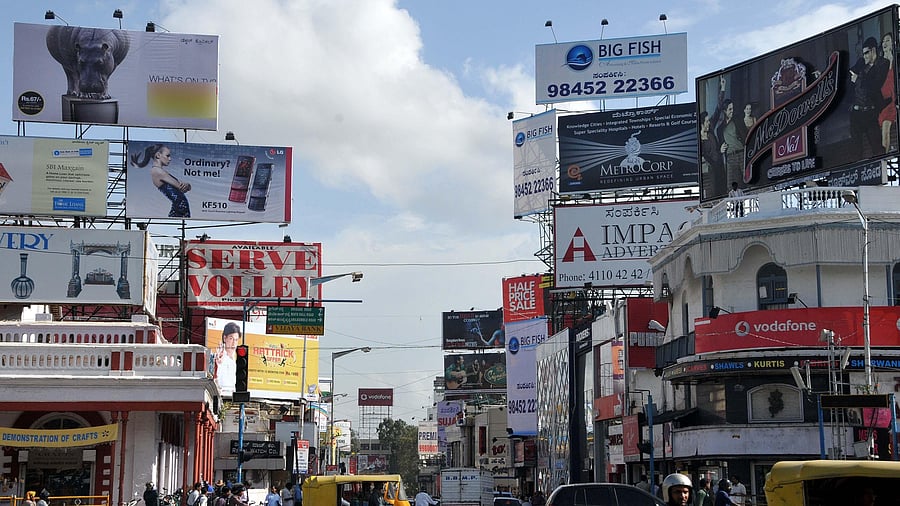
Unregulated usage of hoardings and banners could pose a danger to motorists, activists say.
Credit: DH FILE PHOTO
Civic activists and urban planners have expressed concern over
the state government effectively lifting the ban on outdoor advertisements, which includes hoardings and banners, in Bengaluru. It adds to the clutter and also poses a danger to motorists, they say.
Gangambike Mallikarjuna, former mayor of Bengaluru, points out that when they imposed the ban eight years ago, it was due to a lack of revenue and their contribution to road accidents. “Back then, the advertisers were not paying the taxes and so the revenue was poor. Additionally, we would often hear reports of these roadside banners causing accidents,” recalls Gangambike, who was a part of the council that enforced the ban.
Former corporator, Padmanabha Reddy, notes that roadside hoardings and banners were a necessity at a time when digital advertising and electronic media were not so advanced. “The beauty of the city will be ruined. I do not think this will benefit the government in any way. The revenue generated will not be significant,” explains Reddy, another council member responsible for imposing the ban.
Strict regulations
The Greater Bengaluru Authority (GBA) stands to make a revenue of about
Rs 300 crore, Munish Moudgil, special commissioner (revenue), GBA, tells Metrolife. “The High Court has ordered in a writ petition that it be allowed in a regulated manner after private advertisers went to court. The right approach is putting in place strict regulations and limits with penalties and punishment for violations. That’s what we are doing,” he explains.
Labelling it a ‘sovereignty’ issue, a noted civic activist states that it is strange that the state government should rule on city matters. “Can the Gujarat government ban alcohol in Bengaluru?” he asks, and adds that if the councillors imposed the ban, it should be the councillors who lift it, and not a “third party”. “I would suggest they hold the civic polls first,” he elaborates.
An eyesore
Having returned from Chennai recently, he notes that the flex banners and hoardings were an eyesore. However, there is no clarity yet on whether political banners are allowed under the new rules. He further explains that when a contractor leases the space, he in turn rents it out to a third party at a profit. “The contractor will make a lot of money, but the GBA will only make a fraction of that amount,”
he says.
A more serious concern is the effect non-biodegradable flex banners and posters will have on the environment. “We often find these materials discarded in water bodies around the city,” says Vinod Jacob, an environmentalist. People prefer PVC to cloth banners because cloth banners are three to four times costlier.
However, urban planner Ashwin Mahesh believes “aesthetics could not get any worse”. He reasons that with Bengaluru’s property taxes being so low, compared to major cities around the world, the civic authority needs to find ways to make money. “In Mumbai, the municipal corporation has a budget of over Rs 70,000 crore. In comparison, the budget for places like Kalaburagi and Erode in Tamil Nadu are only a very small fraction of that amount. In Bengaluru, these advertisements will add a few hundred crores to their revenue. I think the state should allocate more money to the municipality,” he says.