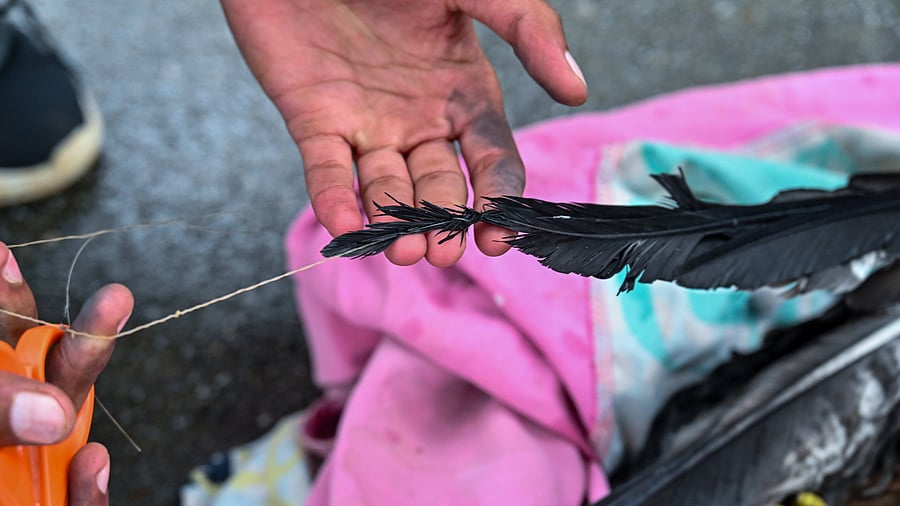
A caretaker tends to a bird injured by manja thread used for kite flying. The nearly invisible strings often hang from wires or tree branches, trapping birds mid-flight.
Credit DH FILE PHOTO
With Makar Sankranti around the corner, kite flying has become a common sight across the city.
However, the use of banned Chinese manja threads has led to nearly 300 birds being strangled or injured in just the first 12 days of January, animal rescuers said.
Rescue groups say distress calls are rising sharply. “Usually, we receive two to three such calls a day. Over the past 10 days, this has gone up to five or six, and on some days even seven,” said a representative of People for Animals (PfA), which runs a wildlife hospital.
While PfA received close to 60 rescue calls this month, the Avian and Reptile Rehabilitation Centre (ARRC) recorded 244 manja-related cases in just 12 days.
“We are seeing a worrying rise in manja-related wildlife casualties even before Sankranti. In less than two weeks this year, we have already rescued 244 animals injured by these deadly strings,” said Subiksha Venkatesh, lead rehabilitator at ARRC.
The Forest, Ecology and Environment Department banned nylon manja in June 2016, but weak enforcement continues to endanger wildlife. ARRC data shows that at least 9,000 birds have been affected by manja threads over the past three years.
“Many manufacturers market these strings simply as kite-flying threads. There is little enforcement, and often no checks to distinguish between cotton and nylon manja. During awareness drives, police do assist us in seizing illegal threads,” said Jayanthi Kallam, executive director of ARRC.
ARRC volunteers have been conducting awareness campaigns at kite-flying events across the city. “At a recent kite festival, about 10 kg of manja was collected and prevented from entering the grounds. Once people understood the harm, many voluntarily handed it over,” said Vijay Gowda, a rescuer with ARRC.
Rescuers said the threads are almost invisible and often get caught on trees or electric wires, causing birds to be strangled mid-flight. The nylon strings can cut deep into birds’ wings and necks, often proving fatal.
Wildlife casualties soar
2019: 349
2020: 1,323
2021: 3,072
2022: 2,381
2023: 2,678
2024: 2,648
2025: 3,614
2026 (till Jan 12): 244
(As reported to NGO ARRC)