
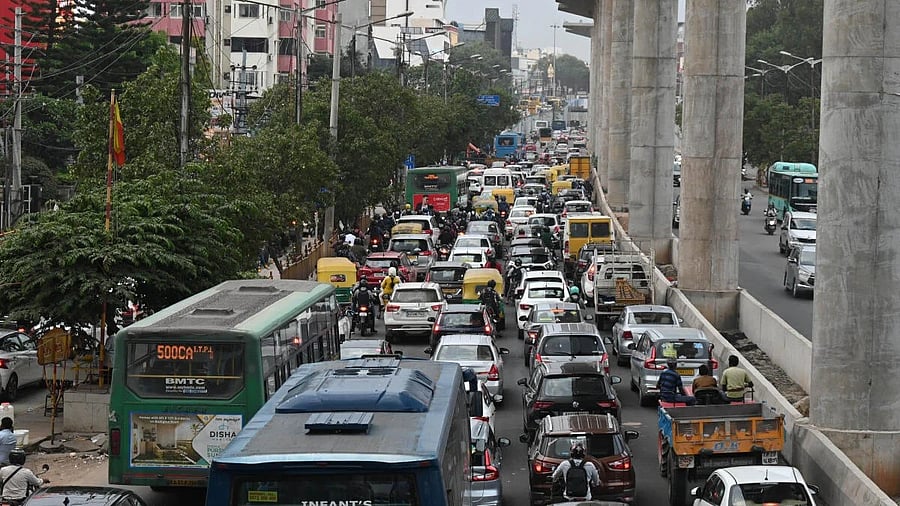
Traffic congestion in Bengaluru.
Credit: DH Photo
Bengaluru: Introducing targeted congestion pricing in dense business districts is among the five measures proposed in the Economic Survey 2025 to address gaps in mass transit services in Bengaluru and other cities.
The core idea, the survey said, is to internalise the external costs of congestion, such as delays, pollution and fuel waste, so that users of the most congested roads bear the true cost of their travel.
This, in turn, is expected to reduce the number of private vehicles during peak hours on heavily congested corridors, improve travel speeds, and encourage public transport use, carpooling and off-peak travel.
The survey cited examples from Singapore and London.
At a high-level meeting in November, Biocon Chairperson Kiran Mazumdar-Shaw had proposed a congestion tax along the Outer Ring Road (ORR), while the Bengaluru Traffic Police (BTP) suggested that large tech parks and private companies introduce pay-and-park systems.
The Economic Survey also recommended legalising and standardising shared autos, e-rickshaws, minibuses and bike taxis through simplified permits, designated pickup bays and app-based integration.
Other measures proposed include -
a) Scaling city bus fleets to 40–60 buses per lakh population and pairing fleet expansion with end-to-end digital systems.
b) Combining interest subvention (to 3–4%), credit guarantees and refinancing to lower tariffs under gross cost contracts and improve project bankability.
c) Implementing the National Transit-Oriented Development (TOD) Policy through 500–800 metre station influence zones, higher FAR, mixed-use zoning and value capture tools to shorten trip lengths and cluster jobs near transit hubs.
Citing a working paper by the Institute for Social and Economic Change (ISEC), the survey estimated that traffic congestion led to the loss of 7.07 lakh productive hours in Bengaluru in 2018, translating into an economic cost of about Rs 11.7 billion.
A 2018 Uber–BCG report estimated that traffic congestion cost Delhi, Mumbai, Bengaluru and Kolkata a combined US$22 billion annually, it added.
The survey underlined that the underlying problem is a growing dependence on private vehicles.
“The vital signs of our cities are poor because roads are used more as storage for vehicles rather than corridors for people. Streets are congested not because citizens are moving excessively, but because cars carry too few passengers,” it noted.
“While private vehicles have their advantages, the problem arises when they become a necessity rather than one choice among several viable options. The lack of alternatives leads to congestion and its resulting ills, as citizens compete for limited road space using geometrically inefficient modes of transport,” the survey said.