
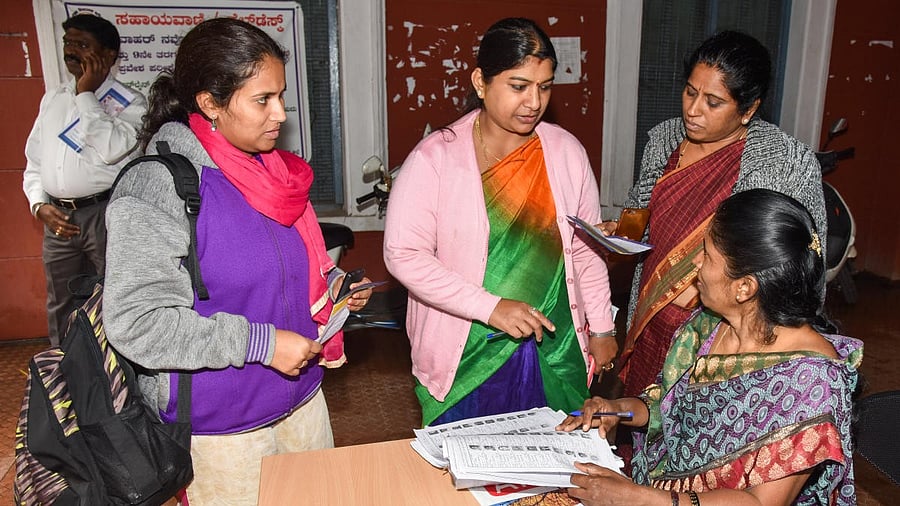
Election officials giving instruction to public in three day special voter registration drive by The Election Commission of India along with BBMP at a polling both, in Public Instruction JD Office, Kepegowda road, in Bengaluru on Friday.
Credit: DH Photo/S K Dinesh
After six years of administration without elected leaders, Bengaluru is now expected to hold municipal elections in May 2026. But there is one big difference: The upcoming elections will help voters elect representatives for five separate corporations rather than a unified BBMP.
The draft electoral rolls for the five newly formed corporations were published this week. The city of Bengaluru has a population of approximately 1.4 crore, out of which a total of 88,91,411 voters have been recorded in the list. The draft electoral rolls were prepared with October 1, 2025, as the qualifying date. The rolls include 45,69,193 male voters, 43,20,583 female voters, and 1,635 other voters, totalling 88,91,411 voters.
Citizens have been asked to verify whether their names appear on the draft electoral rolls and submit applications immediately to get their names included from January 20 to February 3, 2026. During the same time period, Booth Level Officers (BLOs) will visit households for verification.
The disposal of claims and objections will be done from February 4 to February 18, 2026, and the final electoral rolls will be published on March 16, 2026.
Among all wards, Ward No 23 of Bengaluru West City Corporation has the highest number of voters, with 49,530, while Ward No 16 of Bengaluru East City Corporation has the lowest, with 10,926. A total of 8,044 polling stations will be set up across the 369 wards, according to the State Election Commission.
“A proper BLO-based revision needs to take place, as a special intensive revision. Officials must visit every home and verify the voter list before releasing it. It has not happened so far. They have left it for people to come back with their feedback. Such revisions should have happened prior to the publication of draft rolls,” observes R Rajagopalan, convener of Bengaluru Coalition.
“There are data issues in the voting list. Intensive revision helps eliminate them. From the outset, the whole process, including delimitation, has been unscientific. Delimitation was done in closed-door sessions with some officials. The logic and the basis of that delimitation have never been shared. The input data for the delimitation not been shared. So, there is opacity in the delimitation itself,” he explains. He feels the revised list after delimitation requires a correction time period.
Reservation roster
In the past, reservations for various wards were one of the issues that stalled the process, as they were contested by various affected parties. In the last reservation roster exercise done in 2022, the criterion was the population. The BBMP had Scheduled Caste/Scheduled Tribe (SC/ST) data from the 2011 census, but none for backward classes. To decide the percentages of seats to be reserved for OBCs, the government constituted the Justice K Bhaktavatsala Commission of Inquiry for OBC Reservation in Local Body Elections in Karnataka in May 2022.
The Commission report submitted in July 2022 upheld the reservation of 1/3rd of the total seats in favour of OBCs in local body elections, including the BBMP polls. In August 2022, the state government finalised the ward-wise reservation list for the BBMP. The reservation committee fixed reservations for women and OBC by a process called randomisation, in the absence of any other reliable ratio. This was contested again.
The BBMP was finally disbanded, and the Greater Bengaluru Authority came into existence along with five corporations. The OBC survey was done separately, and things started rolling again.
Finally, the delimited ward lists for all five corporations were finalised, and the reservation draft was released. Friday was the last day for objections.
“If there are mistakes, we have time to rectify them. If something isn’t in accordance with the rules, we will fix it. We have submitted the draft to the Supreme Court. We have until February 20th for the final notification, and the Election Commission has until March 16th,” says bdul Wajid, former Opposition leader of the BBMP and current President of the Bengaluru North District Congress Committee.
“The voter list has also been released. Time has been given for objections, and door-to-door verification is happening. A fair election is 100% possible. Only those who feel the ground shifting are raising objections,” he says.
The uneven division of voters into various corporation limits will not adversely affect the governance or the voting process, he argues.
Even then, a major hurdle for the upcoming polls could be objections to the draft ward-wise reservation notification, say observers. Groups unhappy with the reservation are preparing to go to court soon after the final reservation list is published in February if it does not meet their requests for modifications, say sources.
Critics claim the draft violates High Court and Supreme Court guidelines, specifically noting a reduction of eight seats in women’s representation. Some even argue that the government has intentionally created a flawed reservation list to provoke legal challenges. They suggest that if citizens or parties go to court against these “errors,” the elections will once again be stayed.
EVM Vs ballot battle
Electronic Voting Machines (EVMs) used in the Mumbai municipal elections lacked Voter-Verifiable Paper Audit Trails (VVPATs), which display the vote before it is fed into the voting machine. The Maharashtra State Election Commission (SEC), which conducted the election, justified this before the court by stating that the use of VVPAT is not legally mandatory for local body elections.
The SEC had argued that introducing VVPATs would significantly increase costs, logistical complexity, and polling time, especially given the large number of wards and voters in Mumbai. Officials also maintained that standalone EVMs used in municipal polls were sufficiently secure and had been used in past local elections, while VVPATs were prioritised for state assembly and parliamentary elections, where the legal and constitutional requirements are stricter.
In Karnataka, the State Election Commission (SEC) decided to use ballot papers instead of EVMs. This has raised many eyebrows, as the counting process in this method is manual.
Abdul Wajid says even a country like America uses ballots; the most advanced countries in the world, like Germany, use ballot papers.
“Even today, Gram Panchayat elections are held via ballot paper. True, it was our government (Congress) that introduced EVMs. But today, you see that any account can be hacked daily. WhatsApp is being hacked. People are losing crores of rupees after clicking on links. So, can’t an EVM be hacked?” he asks.
He explains the deeper issue that led to the trust deficit. “The Central Election Commission has no patience; they don’t take complaints. No matter what proof we give, they aren’t ready to discuss it in detail,” he says, pointing to the instances in the past where there were complaints against the EVM system, the display mechanism going wrong and other issues.
“In that context, with a ballot paper, when we cast our vote—instead of a button, we apply a seal—you will at least be satisfied that your vote has definitely gone to the party you chose. There is a system where the ballots are taken out and counted. It might take more time and involve more logistics, but it brings a sense of genuineness,” he adds.
However, Rajagopalan says moving away from EVMs is a mistake. “In the current format of the voter list, you will see physical chaos at the booths for sure. In addition, the voting method is being changed to a ballot-based one,” he adds.
“There is a lot of discussion and debate about the veracity of the information that EVMs, as digital tools, have produced. But there is no particular complaint that has reached a logical conclusion, leading to the questioning of EVMs as a whole. We have been reasonably and fairly successful in running the largest democracy with a reasonable degree of accuracy. Throwing the baby out with the bathwater is not a solution, because the world is headed in a digital direction. Comparing us to America or Germany isn’t fair; those aren’t apples-to-apples comparisons,” Rajagopalan explains.
Bengaluru voted with ballot papers more than 20 years ago. What is the issue with ballot papers? Rajagopalan recalls the days of ballot voting. “There were complaints of booth capturing, ballot bundles going missing, and every other way of malpractice, which is why EVMs came into the picture. Now we are going back, and the same problems can recur,” he says.
Wajid says that whether the political parties are happy or not, the voters will be happy. “The State Election Commission has the power to choose the voting method, and they are doing so. A voter’s right should not be diverted elsewhere,” he adds.
He argues that even having VVPAT is not enough to build trust. “The VVPAT was introduced only because these questions of trust arose. You press the button, and it shows on the VVPAT—no doubt about it. But the software is complex. Not everyone is an intellectual who looks at the VVPAT. Many senior citizens and uneducated people just press the button and leave; they don’t even check if the VVPAT is working,” he adds.
“Another issue is that they count VVPAT slips only in very close fights or on a random basis. This is still not a full proof of genuineness. If you are going to count VVPAT slips at all, you might as well just use ballot papers. The result might be delayed, but a fair election will be possible,” he argues.