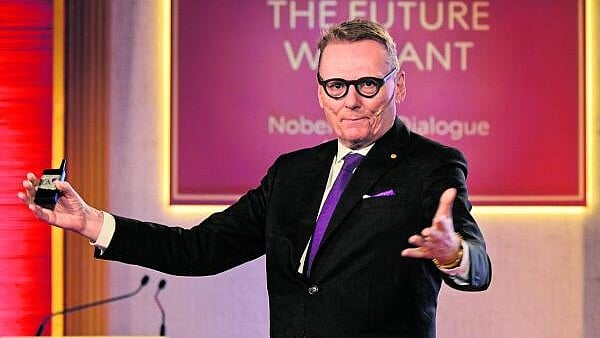
James Robinson, Economist and political scientist addressing at the Nobel Prize Dialogue Bengaluru: The Future We Want at Indian Institute of Science in Bengaluru
Credit: DH File Photo
Bengaluru: The way forward to facilitate both scientific and human progress simultaneously was the crux of the Nobel Prize Dialogue, which took place at the JN Tata Auditorium on Monday.
Hosted by Nobel Prize Outreach in collaboration with Tata Trusts, the philanthropic wing of the company, the event explored the theme 'The Future We Want', intending to foster open exchange and deepen he connection between science and society.
In addition to talks by Nobel Laureates David MacMillan (chemistry 2021) and James Robinson (economic sciences 2024), the event featured two interesting panel discussions.
Delving into 'Institutions and Cities: Engines of Human Progress', the first panel discussion focused on 'The megatrends shaping the world - navigating the next decade'. Joining Laureate Robinson on the stage were Tolullah Oni, a public health physician, scientist, and urban epidemiologist, and economist Montek Singh Ahluwalia.
The way to remove inequality in a country like India is through "better taxation", said Ahluwalia. "You may have inequality before taxation, but you can have greater equality after taxation, if you have the right kind of taxes. But in India, we revel in giving tax exemptions. As a result, the level at which taxes are levied in India, at the ratio of its per capita income, is higher than in any other country," he elaborated.
Speaking on the possibility of a new development model emerging, he said, "While there is movement in moving from the old liberal notion of the 'one way street', it is deeper than that. If you look at the history of economics, it is only an assumption that progress is going to be smooth. In reality, creative destruction is a very important part of the world in any political and economic situation. Unless there is creative destruction, there is no hope for movement."
The second panel discussion on the theme 'Next Big Thing - The Science That Will Shape Our Future' featured Laureate Macmillan, biologist Gagandeep Kang, and biotechnology entrepreneur and scientist Kush Parmar. The panel highlighted the breakthrough in science and technology that will transform health and sustainability.
Speaking to DH, Parmar noted that Bengaluru was at the epicentre of the biotechnology evolution in India. "For technology in general and biotechnology especially, Bengaluru provides an enabling environment for ventures in these fields. When you think about all the things you really need — a critical mass of academic science and medicine, a critical mass of entrepreneurial people, scientists and medicine, the city has the perfect combination of ingredients. It's a great magnet of a place," he said.
Gagandeep also presented a talk exploring how innovation and collaboration can accelerate solutions for humanity's shared future, presenting the example of the cholera outbreak in erstwhile East Pakistan and the India border.
The event also featured a cultural performance by acclaimed artists L Subramaniam and Kavita Krishnamurthy.