
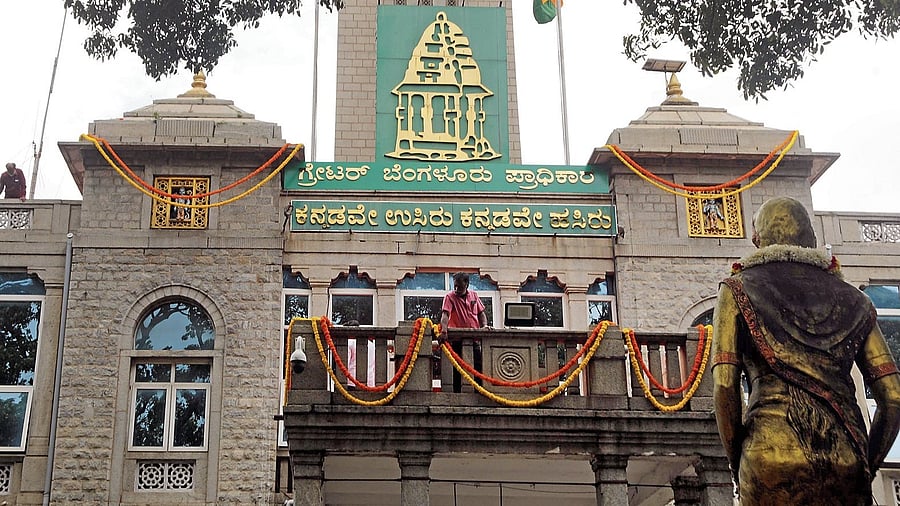
Credit: DH Photo
The last time Bengaluru elected corporators in August 2015, as many as 102 women entered the Bruhat Bengaluru Mahanagara Palike (BBMP), which then had 198 wards. With the formation of the Greater Bengaluru Authority (GBA), creation of five corporations, and delimitation increasing the number of wards to 369, as many as 174 wards will now be represented by women.
The Supreme Court’s directive to conduct the GBA polls before June 30 has evoked mixed reactions among women ticket aspirants. Even as they welcome the increase in reserved seats, women are weary of the “proxy” culture and rotation of reservation that discourage genuine women leaders from building their political base.
“BJP has no dearth of women candidates. In fact, each ward has 4–5 aspirants and candidate selection will be a tough task. A major criterion is her popularity and accessibility to the people,” said Geetha Vivekananda, former BJP Mahila Morcha president and ex-corporator.
She added that the party keeps cadres engaged through people-connect programmes like blood donation drives, health camps and tree plantation activities. “But the long gap has certainly affected development work and corporators’ engagement with people in many wards,” she noted.
Restructuring challenges
Ward delimitation has fragmented existing wards. “Each ward which earlier had a population of 35,000 to 80,000 now has only about 20,000 people. The women reservation has not been applied equally,” allege women leaders.
Calling delimitation a political exercise, Geetha said, “Old wards have been split to favour the ruling party. Some Assembly constituencies held by Congress legislators have fewer women-reserved seats to accommodate male party workers. My old ward, Vijnananagar, has been torn into five pieces.”
Former corporator and BJP leader N R Ramesh said “women reservation stood at 47%, against the prescribed 50%.”
The reservation matrix shows uneven distribution. BJP leaders allege that in Byatarayanpura and BTM Layout, represented by ministers Krishna Byre Gowda and Ramalinga Reddy, only five of 14 wards are reserved for women. But it is the same story in BJP-held constituencies like RR Nagar, CV Raman Nagar, Rajajinagar and Yeshwantpur (now Congress) too.
Women leaders have flagged nepotism, as male leaders often push their wives or female relatives as proxies. The five-year delay, leaders say, has cost an entire generation of grassroots women leaders.
Expelled Congress leader Kavitha Reddy said she was denied tickets in 2015 BBMP polls and again in 2018 and 2023 Assembly elections. “Barring a few serious contenders, women seats are occupied by relatives of male leaders. Women without a political background or mentor cannot get tickets on merit. Often, women are proxies for their husbands. Parties are not keen on nurturing women leaders, and women are trolled and intimidated, making it difficult to survive in politics,” she said.
Former Mayor Padmavati said Bengaluru needs quality representatives. “Parties must give tickets to educated, service-minded women with knowledge of budget and grants. Women, once elected, should not rely on menfolk. Wards headed by women have seen fewer conflicts and better development,” said the five-time corporator, adding that Congress would sweep the polls due to the impact of five guarantees on women and households.
Reddy, a faculty member of “Kranti Sangam,” an AICC programme, stressed the need for training. “Politics remains male-dominated. Women are trained in Constitution, laws, gender justice, gender budgeting and mentorship across India, but Karnataka lacks such initiatives,” she rued.