
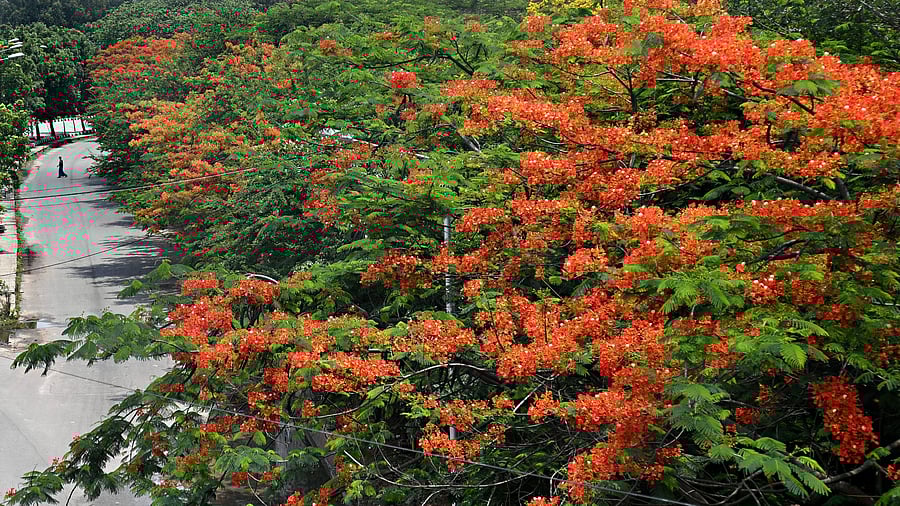
A view of Outer Ring Road in Bengaluru
Credit: DH photo
Bengaluru: As many as 6,868 trees will be affected by Namma Metro's Phase 3, according to the project's Environmental Impact Assessment (EIA) report, down from the earlier estimate of 11,137 trees.
Of the affected trees, 65% will be felled, 15% transplanted and 20% pruned. For trees that will be felled, Bangalore Metro Rail Corporation Ltd (BMRCL) has promised to transplant 10 saplings of native species at Rs 2,000 apiece.
A heritage banyan tree with a girth of 2,700 cm (88.6 feet) and a canopy that extends across 1,242 sq m — among the city's largest — will also be affected, says another study by Azim Premji University professors Harini Nagendra and Seema Mundoli.
Phase 3 will have two elevated corridors totalling 44.65 km. Corridor 1 (32.2 km) will run from JP Nagar 4th Phase to Kempapura while Corridor 2 (12.45 km) will link Hosahalli to Kadabagere along Magadi Road. Slated for completion in May 2031, Phase 3 will expand Bengaluru's metro network to 222.2 km.
Phase 3 has received all statutory clearances but its construction has been delayed due to revised plans to build a 37.12-km double-decker (metro-cum-road) along the alignment.
BMRCL plans to float tenders later this month, with construction expected to begin in June.
BMRCL has claimed that only trees that obstruct construction would be transplanted, felled or pruned as determined by the Tree Expert Committee (TEC) through on-site verification and deliberation. Trees not designated for cutting will not be damaged during construction, it added.
It has also promised to monitor the survival of transplanted trees and saplings for five years and replace dead transplanted trees or saplings every year.
BMRCL has pledged to plant native shrubs and groundcovers in medians under elevated structures to form green belts, improve the streetscape and mitigate environmental impact.
Under compensatory afforestation, BMRCL plans to spend Rs 7.18 crore along Corridor 1 and Rs 1.69 crore along Corridor 2. It will spend another Rs 19.7 crore and Rs 6.26 crore, respectively, on environmental monitoring during construction.
BMRCL received tree-cutting permission for Package 1 (JP Nagar-Mysuru Road) in September 2025 and expects to receive approvals for the entire project by mid-2026.
The project will also impact Bonnet Macaque, a vulnerable species named on the IUCN Red List. BMRCL has planned a species-specific conservation plan.
Dattatreya T Devare of nonprofit Bangalore Environment Trust believes the EIA report does not provide adequate details of the affected trees.
Stating that the BMRCL was not being transparent, he said public consultations were conducted in August and September without providing adequate information beforehand.
"Only a brief presentation was made. How are people expected to provide meaningful comments?" he asked.
He said BMRCL also ignored residents' suggestions to tweak the alignment to save big trees in Nagarabhavi.
What rapid EIA found
According to a rapid EIA by professors Harini Nagendra and Seema Mundoli, 652 trees across 34 species will be affected along the 5.1-km Nagarabhavi–Sumanahalli Junction stretch. Of these, 463 have been marked to be cut while 189 will be otherwise impacted.
The tallest tree marked for cutting is a 15-metre-tall African tulip (Spathodea campanulata).
The trees on this stretch sequestered 280 metric tonnes of carbon, which otherwise would contribute to global warming and climate change, it adds.