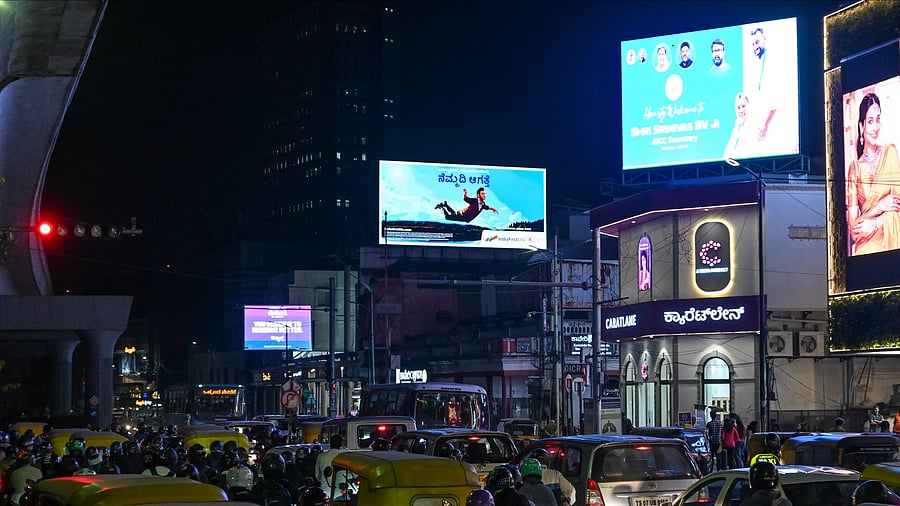
Bright and glaring digital billboards could put motorists at risks, experts say.
Credit: DH PHOTO/PUSHKAR V
Over the last few months, large digital advertising boards have come up at major junctions and along busy roads. Metrolife spotted them at the Lavelle Road and Vittal Mallya Road junction, on Brigade Road, M G Road and at the Good Shepherd Auditorium on Museum. They are distracting and pose a threat to motorists, civic activists and urban planners say.
Though they are not binding, the Indian Roads Congress (IRC) has some guidelines regarding the use of illuminated boards, points out Karthik Reddy, joint commissioner of police, traffic, Bengaluru.
In its ‘Policy on road advertisements’, the IRC states that, “illuminated
advertisements of the following description are objectionable from the angle of traffic safety and should not be allowed: a) advertisements which contain, include or are illuminated by any flashing, intermittent or moving light or lights except those giving public service information such as time, temperature, weather or date; (b) illuminated advertisements of such intensity or brilliance as to cause glare or impair vision of the driver or pedestrians, or which otherwise interfere with any operations of driving; (c) advertisements illuminated in such a way as to obscure or diminish effectiveness of any official traffic sign, device or signal.”
The boards are placed on the facade of restaurants, shops and on top of other buildings, and advertise fashion brands, real estate and more. One can put up a board after relevant permissions from the Greater Bengaluru Authority, said
a source.
S Purushottam, a 28-year-old techie, commutes to his Richmond Town office from his home in Poorna Prajna Layout on his two-wheeler. He shares that digital billboards with constantly changing visuals are “highly distracting especially during evening rides”. Bright screens on dark streets make it difficult to focus, but static displays are “safer”. “Brightness and height need regulation, as some are too low and glaring,” he adds.
“Most of the larger boards are placed at major junctions,” says Jagadish, an advertiser whose board is at the junction of Vittal Mallya Road and Lavelle Road. It is to be noted that the junction does not have traffic lights and witnesses major gridlocks during peak hours and weekends.
“They are not only a distraction but also a drain on resources. Sometimes trees are cut to make these boards more visible,” says Rajkumar Dugar, a civic activist. But he believes it is not as dangerous at junctions.
When placed “thoughtfully at junctions or traffic signals”, they can be used productively to share messages on safety and proper driving etiquette, believes Vinod Jacob, an urban strategist. “LED digital displays are particularly risky on curves and open stretches,” he elaborates.
According to urban planner Sobia Rafiq, these extremely bright moving advertisements are placed at spots that see lots of activity “but that is what makes them dangerous”.
Urban designer Brinda Sastry, explains that they contribute to light pollution and visual clutter. “If located near parks or areas with greenery, the brightness can affect local biodiversity,” she adds. Regulating the brightness, location and size of boards is important. Backlit signs are preferable as glare is reduced. Public spaces where people gather, pause and linger are ideal for dynamic signboards, she tells Metrolife.