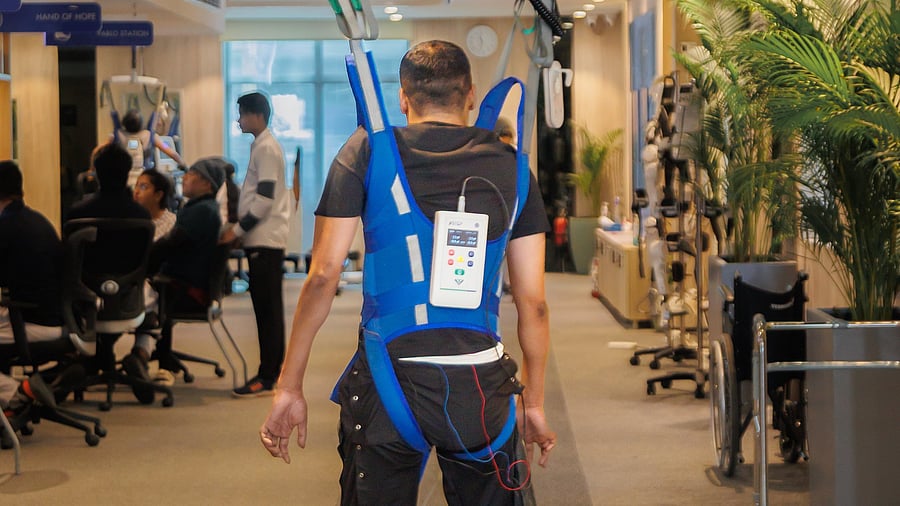
A non-invasive device to improve mobility in people with paralysis, developed by Bengaluru-based Vivatronix Technologies, recently won an investment of Rs 1 crore on a business reality show. The five-member panel of investors called the device “magical” and praised his 17 years of research. One of the panellists, Vineeta Singh, give the wearable product a try and was astonished when her finger moved involuntarily.
xStep is a spinal cord neuromodulation device that delivers electrical pulses to the spine. “Just as a pacemaker activates the heart, this device stimulates the nerves in the spine that control muscles and movement. It can restore some degree of mobility in people affected by spinal cord injury, stroke, traumatic brain injury, Parkinson’s, or cerebral palsy,” explains Parag Gad, the neuroengineering entrepreneur behind it.
Gad says the idea of spinal cord stimulation for movement is not new. It has been studied worldwide for over 25 years. What he and his professor at the University of California, Los Angeles, have done is translate this research into a wearable device for home use. “It also induces neuroplasticity, which means it allows improvements in movement to sustain for hours, even days, after the device is switched off. The device is three to four times more effective than current therapies, many of which are confined to rehab centres. However, we are not claiming it can reverse paralysis,” says the 39-year-old from Hubballi.
Patient stories
So far, around 1,000 patients, aged between 2 and 75 and spread around countries like the US, Canada, Australia, Spain, England and India, have used the device. And “nearly 90% have reported an improvement in quality of life”. Gad shares stories behind these statistics: “A child with cerebral palsy who could not hold her head up can now sit independently. Another, who could not walk even with a walker, is now walking without support. A man with severe bladder issues, who earlier woke up six to eight times a night, now sleeps without interruption.”
Over the years, he has seen families defy odds in their search for rehabilitative care. A family from South America is currently staying in Bengaluru for their child’s therapy. In another case, a man injured in a road accident while visiting Hyderabad from the US was paralysed from the chest down and had to quit his job. When Gad relocated to Bengaluru from the US in 2023, the man’s family moved here to access this therapy. Today, he can sit and walk, has regained some hand movement, eats on his own, and has better bladder control. “The man and his wife have made it their life’s mission to help other families like them and are planning to open a rehabilitation centre in Karnataka,” says Gad.
Though Gad says he is “not very emotional”, one story left him speechless. A man paralysed since the age of 15 approached him for help at 49. “He told me for the first time in his life, he was able to have an erection and be intimate with his wife,” Gad recalls.
Research days
Gad’s father has led several pharmaceutical companies in India. “I kind of grew up in that healthcare space but deep inside, I always thought like an an engineer,” he explains why he gravitated to doing a PhD thesis on ‘Developing electrical neuromodulation devices for paralysis’. The journey was long and challenging. “Many times, just hours before we were to run experiments on animal models, our device would crash, wiping with it, three months of work,” he says, adding that a scientist’s life is “95 per cent setbacks and 5 per cent success.”
Despite this, he recalls the milestones that inspired him to keep going. “The first time we saw a rat walk on a treadmill was quite a moment. Another was when a man in his 40s was able to move his leg after being paralysed for nine years. He was completely shocked,” he recalls.
Since receiving the approval of India’s drug controller last October, over 40 units of xStep have been sold, priced at Rs 3 lakh each. For those who cannot afford it or wish to try it first, therapy is available at Walk Again, a rehabilitation centre in Koramangala. On average, 10 to 15 people are undergoing therapy there daily, paying Rs 2,000 to Rs 3,000 per session.
Gad underscores the magnitude of the problem before us. “In India, about 25 lakh children live with cerebral palsy. Globally, there are probably a hundred million people living with paralysis,” he says.