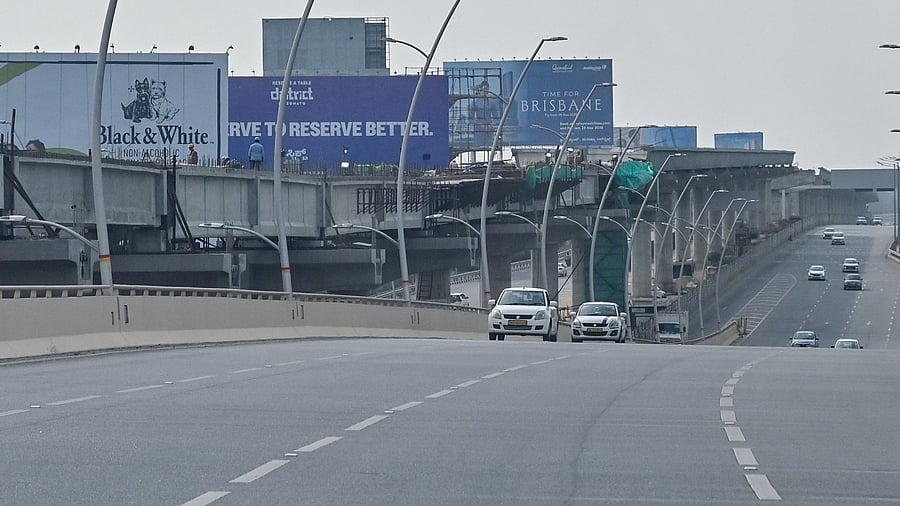
A view of the airport metro line near Kempegowda International Airport, Bengaluru.
Credit: DH PHOTO
Bengaluru: Kempegowda International Airport (KIA), known for its striking architecture and set amid Devanahalli, was envisioned as Bengaluru’s grand gateway to the world. Instead, for many passengers, the journey begins, or ends, in frustration long before they reach the terminal.
Located nearly 40 kilometres from the city centre, the airport’s distance has turned ground travel into a daily ordeal. With limited public transport options, commuters are largely dependent on Bengaluru Metropolitan Transport Corporations’s (BMTC) Vayu Vajra buses or expensive cabs. While the Vayu Vajra is reliable, its frequency and coverage fall short for a city as vast as Bengaluru. Currently, the buses cater to an average of 13,000-14,000 passengers per month. For everyone else, hailing a taxi often means bracing for steep fares, prolonged negotiations, or both.
Bengaluru’s struggle is not unique. Across India, major airports grapple with similar last-mile connectivity challenges.
Chennai International Airport, despite its proximity to the city, suffers from poor integration between metro, suburban rail and road transport, forcing passengers to rely heavily on cabs. Hyderabad’s Rajiv Gandhi International Airport, like Bengaluru’s, is located far from the urban core, making costly taxi rides almost unavoidable for late-night or early-morning travellers. While a 30 km ride from the airport is supposed to cost around Rs 700, taxi drivers at the airport often demand fares exceeding Rs 1,000.
As India’s aviation sector grows, these airports highlight a persistent problem: world-class terminals paired with inadequate, and often exhausting, access for passengers.
Pick-up chaos
In Bengaluru, recent changes in pick-up rules, meant to decongest the airport, have only added to the chaos — leaving passengers confused and taxi unions angry, and sparking repeated standoffs at the terminal.
Under the revised system, app-based cabs are required to pick up passengers from designated zones away from the arrival gates. While the change has worked fairly well at Terminal 2 (T2), Terminal 1 (T1) has emerged as the problem area.
At T1, all commercial vehicles outside the airport’s authorised network were required to pick up passengers from Parking Zones 3 and 4, adding 15 to 20 minutes to the walk from the arrivals gate. While the Bangalore International Airport Limited (BIAL), the airport operating body, made efforts to launch feeder buses and buggies, lack of awareness about the sudden change left hundreds of passengers confused and frustrated.
Furious at not being included in the decision-making process, taxi unions protested the new rules, while passengers launched an online petition demanding their rollback. The changes also drew the ire of several political leaders including Transport Minister Ramalinga Reddy, who criticised BIAL for introducing rules without considering the needs of senior citizens and differently-abled persons.
However, BIAL has stood by its decision, claiming that the new rules will help decongest the airport and improve passenger safety. Earlier, following multiple complaints about taxi driver harassment, BIAL had tried to implement similar rules in 2024. But the move received widespread criticism, forcing the operational body to roll the rules back, only to reintroduce a mildly revised version in late 2025.
After much resistance from both taxi drivers and passengers, BIAL in collaboration with the Karnataka State Tourism Development Corporation is now working on a slot-based system which would allow yellow-board vehicles to pick passengers from the kerbside. The system is currently being operated on a trial basis at T1. In the interim, the authorities have also launched a ‘Premium Pickup Zone’, which allows taxis to pick up passengers from a particular lane near the arrivals gate for Rs 275 for a 10-minute slot and Rs 150 for every additional five minutes.
Despite these efforts, confusion over cab pickups continues to prevail among both domestic and international flyers. “After taking multiple flights, I just wanted to get into a cab and get home. But when I landed in Bengaluru in January, after about 10 months, everything had changed. The driver I always book for pickups could not figure out the new system. We wasted about 30 minutes trying to find each other. The airport staff was of no help,” said Ruchitha Jain, a Koramangala resident.
A similar situation persists in Chennai. The Airports Authority of India (AAI), which manages both the international and domestic airports, had previously allowed passenger cars to pick up travellers directly at the arrivals area. But in August 2025, AAI shifted the pick-up point to the multi-level car parking (MLCP) facility to reduce congestion. Passengers are now required to either walk to the MLCP or take a buggy.
Passengers say that reaching the MLCP from the terminal and then continuing to their destinations can sometimes take longer than the actual flight for short-distance journeys. For instance, Sanjeevi, 39, took about 40 minutes to fly from Coimbatore to Chennai but it took about an hour for him to reach the MLCP to board a cab from the time he deboarded the flight.
“I had to walk from the arrival terminal to the MLCP, which took about 15 minutes. Then I waited for around ten minutes for the lift because of a huge queue. When I reached the parking lot, it took me another 10 minutes to find my cab and board it. It was such a harrowing experience. If only cabs are allowed to pick up passengers at the terminal,” he told DH.
While the Chennai Airport authorities say about 20 battery-operated buggies are available for passenger use, fliers say they are insufficient. Senthil, 47, said he waited 30 minutes for a buggy since he had luggage, only to find that the vehicles didn’t have enough space to accommodate luggage.
Although airport officials have instructed cabs to pick up senior citizens, pregnant women and differently-abled passengers at the arrivals terminal, many drivers avoid doing so, fearing penalties imposed by contractors.
Cab touting
At the Rajiv Gandhi International Airport (RGIA) in Hyderabad, ‘cab touting’ remains a major challenge, inconveniencing passengers through overcharging and harassment by unauthorised taxi drivers.
Travellers often report being tricked into paying high fares, taking longer routes and enduring stressful experiences, especially at night. A persistent issue is the so-called "local mafia" blocking app-based cabs like Ola and Uber from pickup zones. These touts intimidate drivers and mislead passengers about availability, often cramming multiple people into vehicles at exorbitant rates. "Getting Ola or Uber at Hyderabad Airport is a nightmare at night," one passenger lamented on social media recently.
Airport spokespersons insist they ensure 24/7 access to authorised options, including Meru and Skycab radio taxis, Ola, Uber, Rapido, prepaid taxis, car rentals and Pushpak buses. To combat touting, authorities have deployed over 31 anti-touting security personnel at key landside locations. In collaboration with Telangana Police, a special patrol team targets unauthorised operators. In 2024 alone, 446 touting cases were reported to RGIA Police and interception teams.
Traffic chaos at entry and exit points adds to the passenger frustration. "Every five minutes, quarrels erupt at both entry and exit points tarnishing the airport's image. Utter chaos reigns; someone from GMR, the airport operator, must manage it. One says it's a FASTag lane, another disagrees," a passenger complained in a recent video. Passengers continue to urge stricter enforcement to end the ordeal.
While the airport authorities and the police have made efforts to address the cab issues over the years, similar problems pop up from time to time.
Fare scams
At the same time, 2025 saw several cab scams which left passengers in precarious situations.
Recently in Mumbai, a taxi driver cheated an American woman by charging her Rs 18,000 for a cab ride of barely 400 metres near the airport, taking a deliberately roundabout route. The incident came to light after the woman shared her experience on social media, prompting swift police action.
Another common scam at the airport in Bengaluru, which emerged early last year, involved drivers using fake apps or receipts to charge inflated fares.
In June, an elderly woman was charged Rs 2,308 for a 41 km ride to JP Nagar in Bengaluru. Originally supposed to cost between Rs 1,000 and Rs 1,400, the driver showed a fake receipt on his phone with the inflated amount. Over the years, multiple passengers have reported falling prey to similar scams. Most commonly, taxi drivers attempt to charge extra by claiming tolls were not included in the final bill.
“The biggest scam is the convenient placement of premium options like Uber Black right by the arrivals gate. Unassuming passengers walk right into the trap. To make matters worse, cabs which have airport tie-ups and dedicated kiosks on the ground end up charging anywhere between Rs 500 and Rs 1,500 more than the cabs without such ties,” a furious passenger told DH. Since the re-jigging of the pickup zones at the airport in December 2025, several passengers have reported similar issues. However, BIAL is yet to respond to these concerns.
Public transport
Until now, public transport at KIA has been sparse, with the airport railway station lying largely deserted due to poor frequency of trains and often abandoned ticketing booths.
While the station was never well-connected and easily accessible since its inauguration in 2021, the situation has worsened since January 2025, according to contract workers and labourers at KIA, who rely on its service on a daily basis. With tickets priced between Rs 10 and Rs 30, the trains are the cheapest mode of transport available at the airport.
The only other option is the BMTC’s Vayu Vajra which covers 22 routes with 156 buses and 1,061 trips everyday. BMTC plans to add 20 to 25 more buses this year across various routes.
However, despite being one of the cheaper transport options, passengers often complained that the bus travel from the Bengaluru airport was more expensive compared to other major Indian airports.
“The Vayu Vajra doesn’t operate properly during the late hours. Plus, a trip costs anywhere between Rs 300-400 on average. The government should have planned better public transport when they planned to build an airport this far from the city,” said Nandini, 29, a traveller.
BIAL also recently faced criticism for reducing the bus bays for BMTC on T1. While the justification remains that a larger bus stand has been provided at T2, BMTC has shared that about 80% of its airport passengers comes from T1’s domestic terminal. With the government now stepping in, the two bodies are in talks to find a solution.
Relief, however, is on the horizon. The Namma Metro’s Blue Line, which will connect the airport to the city via Hebbal and KR Puram, is expected to significantly cut travel time and provide a reliable alternative to road transport. It is scheduled to be completed by 2027. Additionally, the K-Ride suburban rail project plans to link the airport with key nodes such as Yelahanka and the city centre, promising faster and cheaper access.
“Bengaluru had a railway line well before the airport was built there and yet missed the suburban train system connectivity opportunity,” said Srinivas Alavilli, a fellow at WRI India, a research organisation.
“Recent announcements from K-Ride (Rail Infrastructure Development Company (Karnataka) Ltd) give hope that railway connectivity will become a reality soon. The Blue Line metro is likely to become operational within the next two years but we are yet to see plans like the Delhi Airport Express or how the metro and terminal will be integrated as in the case of Chennai. For a mega city like Bengaluru, with one of India's busiest airports, we need all modes of public transport to ensure seamless connectivity and target at least 50% of all airport trips to happen on bus, metro or train,” he added.
The Mumbai and Navi Mumbai airports are also soon set to be connected by a 35 metre metro line, including a 9 km underground stretch with 20 stations.
A seamless transfer model, supported by multimodal transport — road, metro, suburban rail and water links — will eventually connect the two airports, ensuring that India’s busiest business city operates with infrastructure on par with premier world capitals.
The twin-airport strategy mirrors global precedents: distributing traffic between two facilities to decongest bottlenecks, de-risk operations and provide passengers with greater airline and route choices.
Additionally, the Maharashtra government is addressing the public transport issues through projects by various agencies such as the Mumbai Metropolitan Region Development Authority (MMRDA) and City and Industrial Development Corporation of Maharashtra Ltd (CIDCO).
The ongoing projects in metro, suburban rail and multimodal integration offer hope, signalling that with coordinated planning and effective execution, India’s airports can finally match the efficiency and convenience of the world’s best.
(With inputs from ETB Sivapriyan in Chennai, Mrityunjay Bose in Mumbai and SNV Sudhir in Hyderabad)