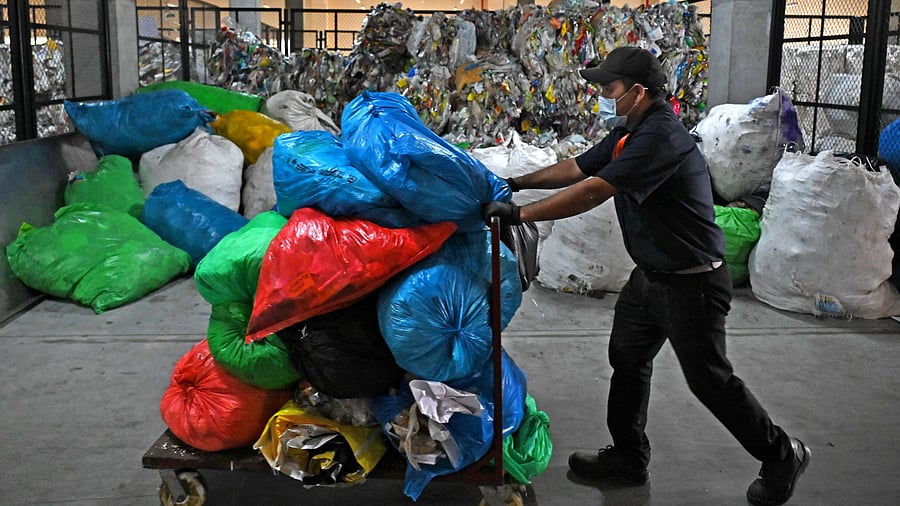
A solid waste management facility in Bengaluru.
Credit: DH FILE PHOTO
Bengaluru: Nearly a decade after the Centre notified the Solid Waste Management (SWM) Rules in April 2016, several states are still struggling to comply with basic requirements, with the Central Pollution Control Board (CPCB) flagging serious gaps in implementation.
The CPCB examined the annual reports submitted by states and Union Territories (UTs) for 2023–24 and 2024–25 under Section 24(4) of the Rules.
The review forms the basis of the board’s consolidated annual report on the status of SWM implementation by local bodies and includes recommendations to strengthen the waste management regime.
Reports for 2023–24 revealed major deficiencies, including the absence of basic data such as waste processing capacity, the number and capacity of scientific landfills (SLFs), and the location of unscientific dumpsites.
For instance, Karnataka reported 158 “operational landfills”, but did not disclose the quantity of waste dumped at these sites.
Several states failed to provide details on the quantity of solid waste collected, while in some cases the figures submitted were inconsistent.
In Madhya Pradesh, Andhra Pradesh and Chhattisgarh, the CPCB noted that the quantity of waste treated and landfilled exceeded the total waste generated.
Problems persist
The gaps continued in the annual reports for 2024–25, with most states again failing to provide details on SLFs.
Karnataka did not furnish information on the capacity or location of SWM processing facilities, while Tamil Nadu reported having “no operational SLF”.
Madhya Pradesh once again showed more waste being treated and landfilled than generated, while Kerala reported collecting more waste than it generated.
Jharkhand, Gujarat, Maharashtra, Uttar Pradesh and Lakshadweep were among the 16 states and UTs that failed to submit their annual reports for 2024–25. The CPCB has asked these states to submit the reports and provide the missing details within 15 days.
Politician–contractor nexus
CM Subbaiah, who led ward-level SWM initiatives in north Bengaluru for over two decades, said waste management would improve only if the politician–contractor nexus was dismantled.
“Waste management begins with segregation at source. What we need is decentralised waste collection and management, for which local bodies must be empowered. Breaking the politician–contractor nexus is essential to create such an environment,” he said.