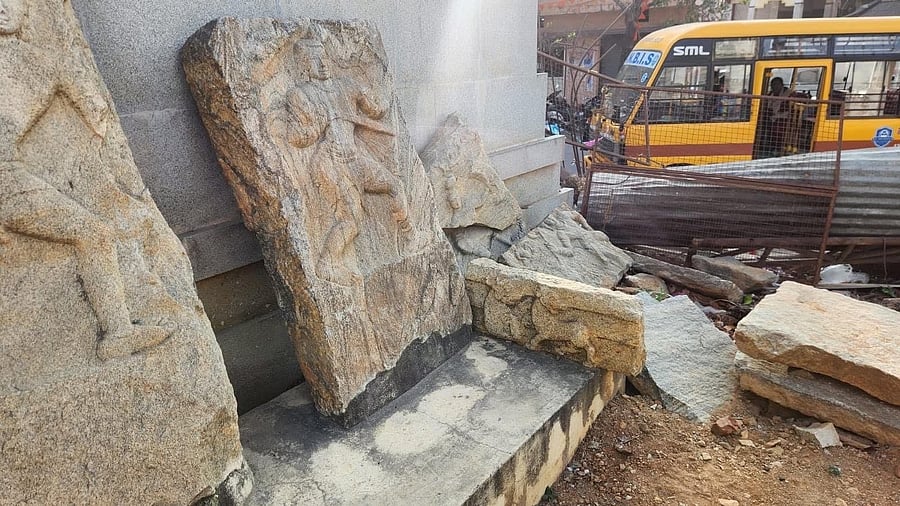
Historically important structures lie in a neglected state at a temple in Begur near Bengaluru.
Credit: special arrangement
Long before Bengaluru became a city of flyovers and expanding neighbourhoods, early dynasties such as the Western Gangas shaped its landscape. Scattered across the city, archaeological remnants — from temples, idols, tanks and inscriptions to burial markers and megalithic structures — offer rare glimpses into centuries of cultural, religious and social life. Even as these sites endure rapid urbanisation, many remain neglected despite falling under the care of the Archaeological Survey of India (ASI) or the State Archaeology Department.
The Panchalingeshwara Temple complex at Begur on the Bengaluru-Hosur highway is a temple built during the 9th and 10th century by the Western Ganga dynasty. The Western Gangas had built the shrines of two important deities Nageshwara and Nagareshwara and in the 11th century, the Cholas added three more shrines of Choleshwara, Kali and Kanteshwara. The five shrines showcase early Dravidian architecture style such as the pyramid-shaped tower over the main garbhagriha or the sanctum and multi-layered tower called the gopurams.
The temple drew wider attention over years after an inscription found here was identified as one of the earliest references to Bengaluru, described as ‘Bengaluru Kalaga’ in the 9th century. While the State Archaeology Department has undertaken some repairs, heritage experts say the efforts at conservation and research into the significance of the remains have fallen far short of what is required.
Misinterpreting history, an idol of goddess Durga that was once located in the bed of Begur Lake has now been placed in a water trough within the temple complex, reportedly under the mistaken assumption that it represents Ganga Devi.
Along with this, broken and damaged veeragallus (hero stones) of the temple lie neglected amid garbage, construction waste and debris while several inscriptions remain exposed, inaccessible and without protective covers or interpretive signage.
Shashidhara H G, a historian of architecture and heritage, said placing idols of goddesses near water bodies was common during the Ganga period. “This idol of Durga was discovered when Begur lake was redeveloped but was placed in front of the temple in a water trough considering it to be Ganga. Similarly, a Durga idol was found near Hebbal lake as well,” he said.
According to temple authorities, there are plans to construct a separate shrine for the idol on the riverbank. “But there is no clarity on what the authorities intend to do,” Shashidhara added.
Nallur temple
Hidden within a 600-year-old tamarind grove — India’s first designated biodiversity heritage site — the Nalluru Chennakeshava Temple stands in advanced decay. Located about 10 kilometres from Kempegowda International Airport, the temple, built with red-tinted stone before the 15th century, has been overtaken by vegetation, with tree roots splitting walls and dislodging stone blocks. Most of the temple’s idols have disappeared. Despite all the odds the temple has gone through, one wall still preserves detailed sculptural panels depicting episodes from Lord Krishna’s childhood. “Even after repeated attempts, no restoration proposal has moved forward,” said an archaeology expert who wished to remain anonymous.
Treasure hunting has further compounded the damage. “People dug up the site believing there was hidden treasure. The roof has collapsed and one of the side walls has given way. Treasure hunting has led to severe structural damage— a pillar with inscriptions in front of the temple was broken into three pieces and discarded. The temple remains unprotected, with neither the State Archaeology Department nor the Archaeological Survey of India including it in their list of protected monuments.
“We are planning to clean the temple premises with the help of NSS volunteers. We are also looking for individuals or organisations willing to adopt the temple through Corporate Social Responsibility or philanthropic support,” said Kavyashree, Deputy Director, State Archaeology Department, Bengaluru Division. She added that financial constraints continue to restrict the department’s capacity. “Managing existing protected monuments itself is a challenge. Adding new ones is not feasible at the moment.”
Megalithic tombs
Discovered by the ASI in 1916–17, the megalithic burial site at Managondanahalli in Devanahalli taluk dates back nearly 3,000 years to the Iron Age. The 125-acre site once featured stone circles, cists and granite menhirs. “This site has burials with stone slabs placed above and below the body along with objects used by the deceased, such as stone pots, as was the practice during the stone age,” said Shashidhara. “Treasure hunters destroyed the site believing valuables were buried there.”
Over 40 menhirs were recorded during the ASI survey held in 1916-17. None remain today. Though officially protected by the ASI, the site has lost most of its menhirs and stone pillars, while the remaining structures are badly damaged. A stone quarry operating nearby has further threatened the heritage site. Despite being under ASI control, the area lacks security personnel, fencing or even basic signboards.
The Greater Bengaluru Authority (GBA), in 2025, proposed setting up of a heritage cell to safeguard heritage sites within city limits. However, implementation remains pending. “We are yet to begin work on the cell unit, but it will be done soon,” said GBA Chief Commissioner Maheshwar Rao.
Separately, the state Muzrai Department has announced plans for a heritage conservation initiative focused on temples in Karnataka. Minister for Transport and Muzrai, Ramalinga Reddy, said a vision group has been formed and they are looking to collaborate with CSR and philanthropic funding to support heritage conservation.