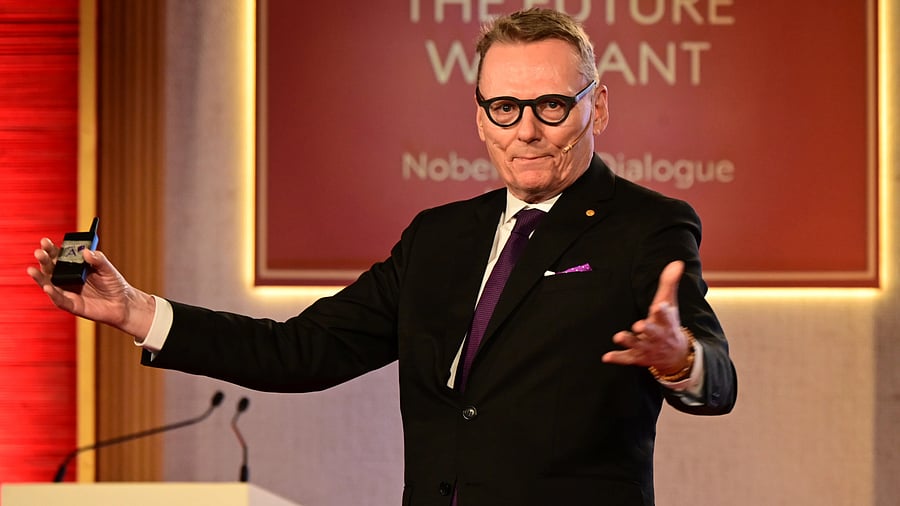
Nobel laureate James Robinson and David MacMillan deliver a talk at Nobel Prize Dialogue, in Bengaluru on Monday.
Credit: DH Photos/B K Janardhan
Bengaluru: Nobel laureate James Robinson explored the possibility of the current society having reached an inflection point in prosperity and progress, during his talk at the Nobel Prize Dialogue on Monday.
Robinson was awarded the Nobel Prize in 2024 in economic sciences for studies of how institutions are formed and affect prosperity. Robinson was also a recipient of the 2024 Sveriges Riksbank Prize in Economic Sciences in Memory of Alfred Nobel.
In his talk, he explored the theory of the ‘One Way Street’. Explaining the concept, he said, “When did theorising about prosperity and progress start? You could cut into that at many points in world history. But one way to do it would be with two Scottish gentlemen — Adam Smith and Adam Ferguson. So Ferguson and Smith, they were in Scotland in the second half of the 18th century. They were looking at all tectonic things that were going on in their societies, urbanisation, industrialisation and a radical transformation. And they came up with a theory. I’m going to call it the one-way street theory. As per that, the more you are like us, the better. This view of the world had a fundamental impact on social theory.”
However, the ‘one way street’ could never exist in reality, he highlighted.
“It’s always a two-way or a multiway street. Liberalism wasn’t something that traced itself to the Greeks, and the Greeks weren’t exactly what they’re made out to be by John Stuart Mill. In reality, everything was and remains borrowed. We all have a lot to learn from each other in a way that’s not possible in this one-way street model, where people like me are supposed to be telling people like you on how you should organise your societies. It’s my experience that doing research in the developing world in the past 30 or 40 years has never worked out like that,” he elaborated.
In his closing remarks, Robinson highlighted the scope for reinvention and the possibility of a new economic model in recent times.
Credit: Special arrangement
Credit: Special arrangement
Catalysis is future of science says David MacMillan Speaking at the same event David MacMillan who won the Nobel Prize in Chemistry in 2021 with Benjamin List for the development of asymmetric organocatalysis provided insight into what organocatalysis means and its relevance in today’s world.
“One of the biggest futures in science is actually catalysis. Catalysis is absolutely massive... Catalysis makes existing chemical reactions easier and faster but more importantly it takes chemical reactions that were impossible and makes them possible. In fact 90% of the world’s chemical reactions on an industrial scale use catalysis and 35% of global GDP at present is based upon catalysis,” he stated.
His focus specifically lies on organocatalysis —It is the acceleration of chemical reactions using small organic molecules instead of traditional metal or enzyme catalysts. So far the number one application of organocatalysis has been for medicines and for making medicines. He also highlighted its prominent use in India.