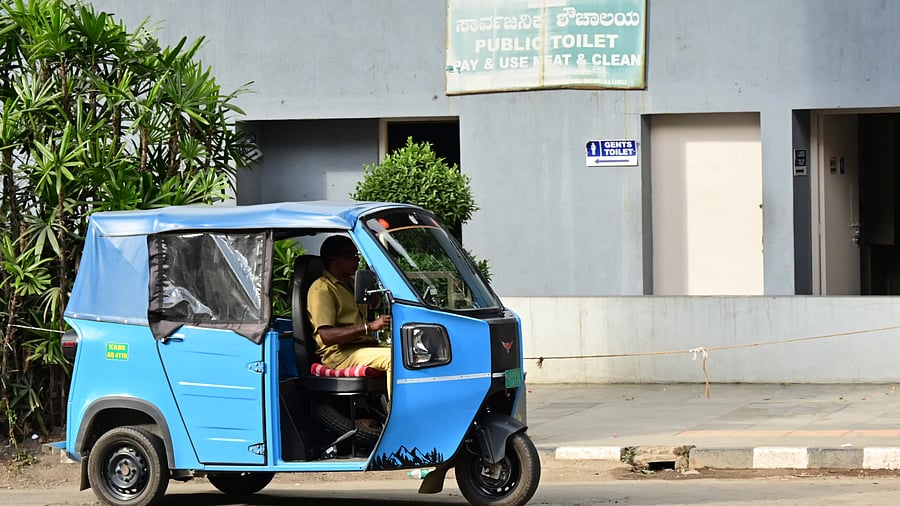
Women drivers suffer the most, having to choose between health risks and the pressing need to earn.
Credit: DH Photo/BK Janardhan
Bengaluru: For Bengaluru’s autorickshaw drivers, especially women, the greatest daily challenge is not traffic or fuel costs, but unhygienic public toilets that lead to significant health risks.
Drivers who spend long hours and travel far from home depend entirely on these facilities.
Rajeshwari S, an auto driver, shared: "I do not prefer using public toilets, but sometimes I have no choice. So far, I have contracted urinary tract infections (UTI) twice.”
The situation worsens during menstruation.
Pooja Raju, another driver, explained: “If we do not work during our period, we lose money, but if we do, there is nowhere clean to change sanitary napkins.”
While she avoids public toilets on most days, Pooja said doctors have warned her that holding in urine for long hours is unhealthy.
Men also report health concerns and unbearable stench.
Shivakumar, an auto driver, said: “I start my day as early as 4.30 am and work till 9 pm, so public toilets are our only choice, and the condition is pathetic.” He stressed that keeping facilities clean is the shared responsibility of the corporation and users.
Medical professionals have validated drivers’ concerns.
Dr Santosh K, Associate Consultant, Urology and Renal Transplantation, said poorly maintained public toilets significantly increase UTI risk. He warned that women who avoid washrooms and hold urine for long hours, a widespread practice to avoid dirty facilities, face even higher risk.
Dr Caranj S Venugopal, Consultant, Urology and Renal Transplantation, suggested that basic safe practices such as washing hands and using toilet seat covers could help reduce risk. The urgent need for the municipal corporation to upgrade and maintain these facilities remains a critical concern for the city’s transport workers.