
Theatre audience expects a stage set up where actors appear to perform and when the word ‘object theatre’ comes up one might think that the play will comprise props.
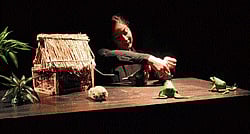
However, once you witness ‘object theatre’, the definition of the art of acting will transform! It did, at least, for those who recently witnessed Choiti Ghosh’s A Bird’s Eye View at Studio Safdar in Shadikhampur (better known as Shadipur).
Directed in collaboration with Ruma Ghosh and performed solely by Choiti, the ‘act’ is a non-verbal play which tells the tale of Milu, a carrier pigeon. With barely a handful dialogues in English, the narrative presents the story of a war from Milu’s point-of-view. From the time of his birth to his training and during time spent with friends, Milu’s mission is to deliver messages.
The narrative follows events on an imaginary warfront, with missiles flying, gun battles and bombs, flying sand, all of which is enacted by Choiti onstage and ably supported by soundtrack. Especially impactful are scenes where Choiti creates a battlefront by placing figurines (belonging to different camps and boots) over a soil spread on a table and then proceeds to enact the war with lighting, battle cries and catchphrases like One, two buckle your shoe....
She also depicts Milu’s fears and reactions to what is happening through her expressions and voice modulation in scenes of distress and loneliness. Objects such as plastic birds, animals, boots, globe, houses etc and their actions were supported with appropriate sounds and light during scenes of flood, war, travel and celebration. Yet, the play was not for children only.
In fact, it required a certain sense of maturity that a child may lack. Choiti agrees with this drawback, “Object theatre is often mistaken for a puppet show but it is a completely different theatre form. The story follows certain ambiguity which a child may find difficult to interpret. Thus, I deliberately do not define an age group as my audience. Since the popular perception is that ‘object theatre’ will have objects, it is assumed that the play is for kids only. But the narrative is referential and needs to be understood in depth.”
It did come as a welcome surprise though, when children in the audience were left spellbound too. Bhavya Rajput, 10, said, “The play was excellent and the story good but I liked the narrator’s acting the most.” It appears logical then that the country’s sole ‘object presenter’ does have a bright future ahead.