
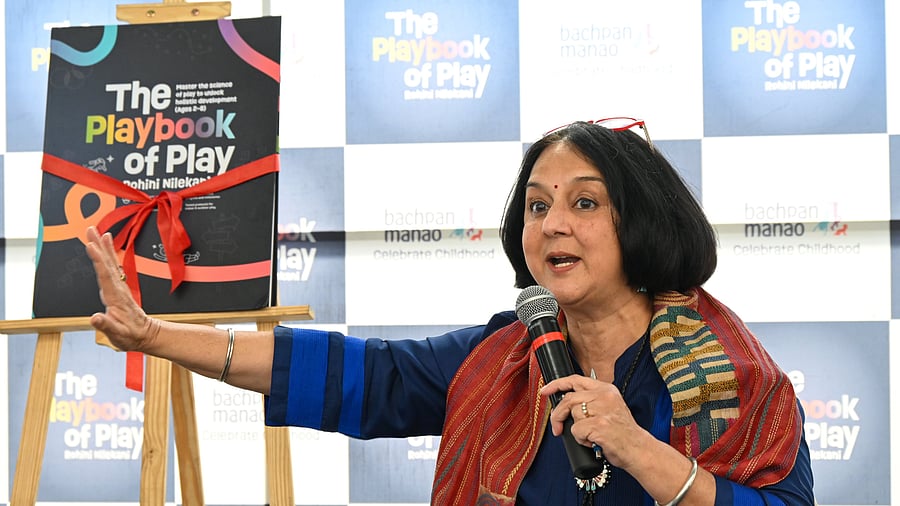
Author Rohini Nilekani at the 'Bengaluru Hubba' at Freedom Park on Saturday.
Credit: DH Photo/ B K Janardhan
In an era where childhood is increasingly defined by rigorous schedules and glowing screens, philanthropist and author Rohini Nilekani offered a powerful provocation to parents on Saturday. Amid the joyful cacophony of the children’s festival Makkala Hubba at Freedom Park, Nilekani launched her latest book, The Playbook of Play.
The book, however, comes with a twist: it consists almost entirely of blank pages.
Launched under the aegis of ‘Bachpan Manao,’ a national mission focused on the importance of the early years, the book serves as a metaphorical permission slip for caregivers. During the launch, Nilekani emphasised that the most critical development in a child’s life happens not through instruction, but through “free, unstructured play”.
“We have put our children into so many little boxes where they cannot find themselves anymore,” Nilekani said, addressing a crowd of parents and educators. “Play doesn’t need a manual. These blank pages are a reminder to let children explore and enjoy childhood their own way.”
The event highlighted a growing concern among urban parents: the “fear of falling behind”, with parents noting the mounting pressure to enrol children in endless extracurricular activities.
In response, Nilekani cited neuroscience, noting that nearly 80% of brain development occurs before the age of eight, primarily fuelled by neuronal connections formed during self-directed discovery.
“Don’t sacrifice the childhood of the present for the anxieties of the future,” Nilekani urged. She described the book as a tool to “free parents from the tyranny of the screen” and allow children to reclaim their natural instincts for curiosity and empathy.