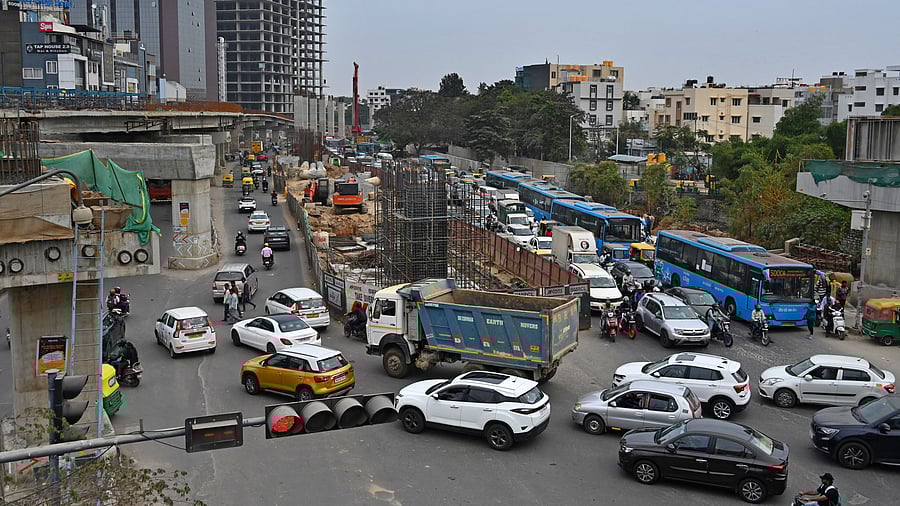
Bengaluru: A 10-member Technical Advisory Committee (TAC) of the Greater Bengaluru Authority (GBA) has cleared a Rs 450-crore revamp of the Outer Ring Road (ORR) between Silk Board Junction and KR Puram.
The project, which includes redevelopment of both the main carriageway and service roads, will cost Rs 26.47 crore per kilometre, making it among the most expensive road redevelopment works undertaken in the city.
The 17.01-km corridor has been split into two packages: Silk Board to Iblur Junction (5.44 km) at a cost of Rs 143 crore, and Iblur Junction to KR Puram (11.57 km) costing Rs 307 crore.
Passing through six major junctions — including HSR Layout, Agara, Iblur and Marathahalli — the stretch forms the backbone of Bengaluru’s technology corridor. The area employs an estimated 6.42 lakh people, about half of whom commute using 3.38 lakh personal vehicles.
According to the Detailed Project Report (DPR), around 35% of the main carriageway and 20% of the service roads are in a distressed condition.
The TAC has recommended Full Depth Reclamation (FDR) instead of routine asphalting for sections prone to repeated damage. FDR involves pulverising existing pavement layers and stabilising them with binders to create a new base — a technique rarely attempted at this scale in Bengaluru.
The committee, headed by RK Jaigopal, has directed authorities to examine the feasibility of incorporating a long-term maintenance clause, requiring the asphalt pavement surface to be maintained to prescribed standards for 10 years after completion of the works.
To increase road capacity, secondary medians and existing bus stops will be removed to create at least one additional traffic lane. Bus stops currently located on medians will be shifted to the footpath side. The committee also instructed that uniform, wider footpaths and continuous cycle tracks be included, while noting issues related to incomplete land acquisition and misaligned property boundaries.
Officials from the East and South City corporations and the Bangalore Development Authority (BDA) have been asked to conduct joint inspections, verify Joint Measurement Certificates, and prepare updated lists of properties already acquired and those still pending acquisition.
Other directions issued by the committee include the use of Stone Matrix Asphalt (SMA) for resurfacing flyovers, provision of modern street lighting beneath Metro columns, examination of the feasibility of constructing a bridge at the Doddanekundi railway crossing, and relocation of the Muneshwara Temple to facilitate service road widening.
The TAC has also directed that all eight flyovers and three underpasses along the corridor undergo structural assessments, an exercise that was last carried out about three years ago.