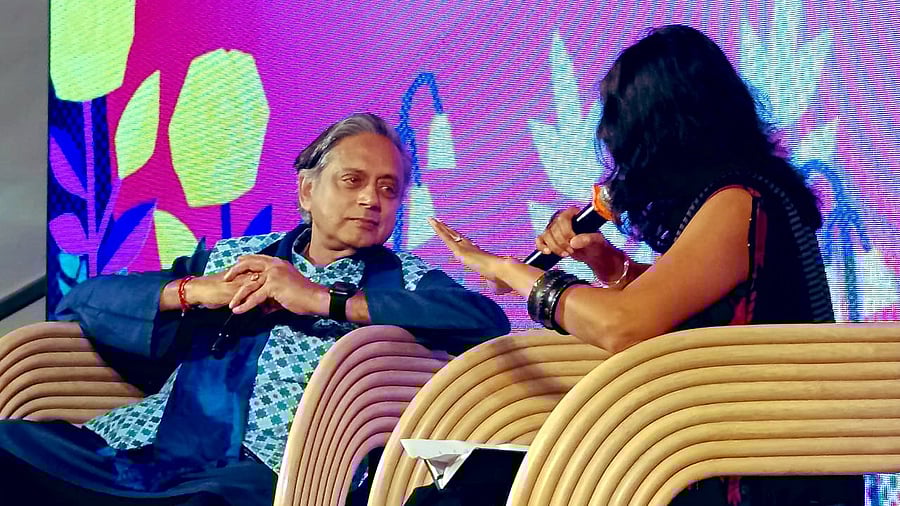
Screengrab from video.
A viral Instagram reel of Shashi Tharoor validating Bengaluru’s English slang at the recent Bangalore Literature Festival has sparked debate. The city’s “Bangalore English” is often trolled online for being “incorrect”.
In the reel, which has 1.8 million views, Tharoor responds to an audience member who says ‘Bangalore English’ is used commonly among friend groups but can sound odd at first. Tharoor responds by saying “never encountered Bangalore English”, but adds that “nothing is wrong if it is understood”, noting that “as long as the expression means the same thing” to the speaker and the listener, it is not wrong.
The video has triggered debate online and offline, with many Bengalureans celebrating Tharoor’s stance and others arguing that “original Bangaloreans don’t talk like that” and that the slang comes from “outsiders”. The dialect, widely used among the city’s youth, includes phrases like “put off one scene” (let’s hang out), “got belted/thulped” (got into trouble), and “let’s dip” (let’s leave).
Metrolife spoke to English-language experts about Bengaluru’s unique slang. Literary critic G N Devy explains that each generation reshapes language by adding or removing words based on culture and context. “Slang is essential, like a fresh coat of paint on an old house — it prevents the language from becoming stagnant,” he says, adding that Bengaluru English is a smaller dialect of Indian English.
B N Balajee, a retired English professor from Mysuru, describes English as “a potpourri of languages”, noting its long history of borrowing from various cultures. He sees Bangalore English in the same light, saying it “creates intimacy by blending words from English and Kannada”. Suchismita Chaudhari, English teacher at Bishop Cotton Boys’ School, notes that many of her students use Bengaluru slang informally but are also fluent in formal English. While she encourages self-expression, she suggests “alternative phrases for exams to prevent slang from affecting their written assignments”.
Etienne Rassendren, a retired English professor, observes that spoken English is based on local influences. Every dialect, he says, has its own “colloquialism”. He believes that as long as people are understood and accepted, “they are free to express themselves however they can”.
Bengalureans have mixed opinions. Karthik Sethunarayan, a city native, describes the slang as “a direct translation of Kannada,” citing examples like “simp-simply” (sum-sumne) and “like that only” (hage ne). While outsiders may find it odd, he notes that bilingual speakers often blend languages, typically among close friends. “Otherwise, most people stick to standard spoken English.”
Social media personalities feel…
Metrolife spoke to Bengaluru-based social media personalities who use Bangalore English in their content. Poorav S, posting as @pooodup on Instagram, believes Bangalore English simplifies communication, citing phrases like “put scene” instead of “let’s hang out”. Though he hasn’t faced online backlash, people are often surprised he uses the slang outside of his videos.
Stand-up comedian Sachin Kumar, known as @gommaboy, credits the mix of cultures in Bengaluru for creating “Bangalore English,” though he notes many avoid it because it’s seen as “too local”. Instagram personality Selwyn D’souza, who posts as @sellydsouzaaa on Instagram, says the slang naturally comes from living in the city, “helps people connect, break the ice, and creates a sense of belonging”.
Ikyatha Yerasala, known for her Instagram page @Slangaluru, posts about the meanings behind Bengaluru slang, noting that while many relate to her content, others reject it, claiming “original Bangaloreans” don’t use it.