
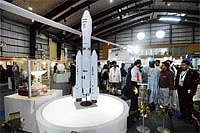
Designed and developed by a consortium of seven engineering colleges from Bangalore and Hyderabad, STUDSAT has triggered a huge interest. About 25 educational institutions and universities have shown such an interest, according to Raghav Murthy, Project Director, Small Satellite ISAC, ISRO.
The country's first pico satellite, STUDSAT along with Catrosat 2B was put in orbit by a Polar Satellite Launch Vehicle on July 12 with the help of ISRO. Murthy said the interest in building student satellites has also been spurred by the fact that many students overseas have built satellites and launched it. Indian students now feel they had the competence and are eager to build one, he said.
He said the colleges were asked to hold on for now since four more student-built satellites were yet to be launched. He was speaking on the sidelines of the Bengaluru Space Expo 2010, a four-day exhibition on space, satellites and technologies.
The four satellites were Jugnu, built by IIT Kanpur students which had 'IR camera', Pratham built by IIT Mumbai which would measure free flowing electronic content and two others by Satyabhama and SRM University in Chennai to measure trace gases in the atmosphere.
Work together
Murthy said the institutions were asked to join together and work on a project rather than each doing it individually. The students involved in the projects were drawn from second year BTech to fourth year students of the course. ISRO provides guidance, consultancy and testing facilities.
The entire cost of building the satellite, which roughly runs into a crore, was borne by the institutions themselves.
"The launch of the satellite was free," he said. A team from ISRO has been identified to help students in building satellites and reviewing their work. He said that many of the students displayed great passion in the project.
"We had one student who had conducted 300 simulations of an antennae and had checked on three different software. Such is the dedication," he said.
As part of the Space Expo was another talk on “Commercialisation of Space-Remote Sensing Systems Applications and Value Additions,” where senior space scientist Tom Snitch felt that paid satellite images should also be seen as an option along with providing free images.
He felt the need for a successful business model that could generate revenue because the satellite imaging have become too expensive. He cited an example of the recent oil spill in the Gulf where free images were given to help governments to find out solution to study its impact on ecology.