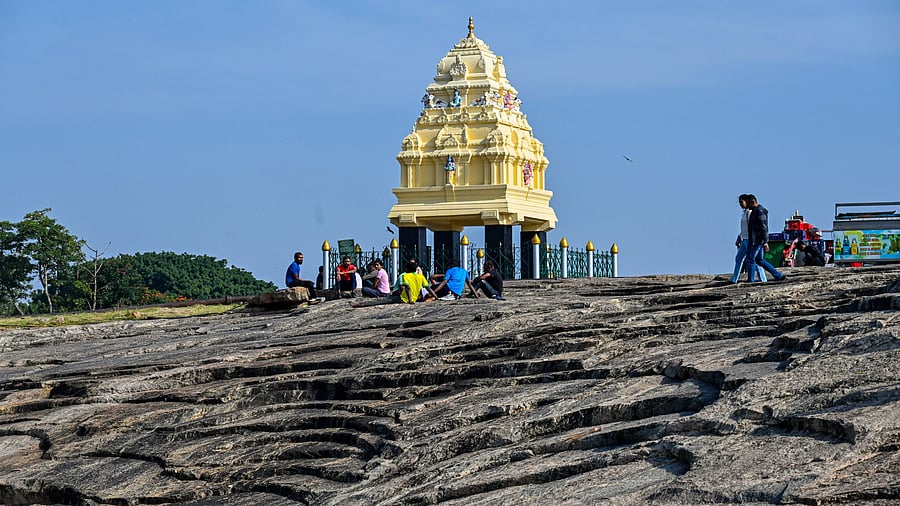
The three-billion-year-old rock formation at Lalbagh Botanical Garden, along with its fragile surrounding ecosystem, faces potential threat from the proposed tunnel road project.
Credit: DH PHOTO
Bengaluru: Long before Bengaluru’s proposed tunnel road became a political talking point, it had already drawn scrutiny on a more fundamental front — its very design.
An expert committee, constituted by the state government, had found that only “bare minimum” geological investigations were carried out for the 16.74 km underground corridor between Central Silk Board and Hebbal, warning that such shortcuts could spell trouble once excavations begin.
While the tunnel road, a proposed signal-free link between two key junctions, is touted as a long-term fix for Bengaluru’s traffic woes, it has drawn criticism over its feasibility, environmental impact and inadequate geological assessment.
As per the current plan, which received government’s approval in June this year, the Bengaluru Smart Infrastructure Ltd (B-SMILE), a special purpose vehicle (SPV) in-charge of large infrastructure projects, will borrow Rs 9,303 crore to fund the project, covering the portion beyond 40% of the total cost. This includes Rs 800 crore for land acquisition.
DH illustration.
The remaining 60% of the construction cost, estimated to be Rs 10,619 crore, will come from the private concessionaire, who will have the right to collect tolls for 30+10 years, besides getting free access to a total of six acres of land for commercial development.
Unlike National Highway Authority of India (NHAI), B-SMILE has no independent revenue stream or stake in the toll income during the concession period. The loan it plans to raise for the project is expected to be repaid through municipal sources of income such as advertisement tax revenues and premium FAR (floor area ratio) charges.
Warnings from within
When the Detailed Project Report (DPR) for the tunnel project was prepared, there were allegations that it was riddled with errors and had copied data from other agencies. Consequently, in April this year, the committee of tunnelling experts was constituted to review the DPR, a key document that serves as the foundation for tendering and execution of the project.
After a month-long scrutiny, the expert committee red-flagged a total of 121 loopholes in the DPR. And the findings were alarming.
Among the sharpest criticisms were the absence of detailed geotechnical studies, traffic survey analysis and the proposal to build a shaft near the Lalbagh Botanical Garden, an area marked as environmentally sensitive. The committee also observed that the DPR did not include as many as nine “important elements”, including a land acquisition plan, tree enumeration and environmental impact assessments.
Shaken by the report that flagged serious technical lapses, the government directed the B-SMILE to revise the DPR, which itself was prepared at a cost of Rs 9.5 crore. Two weeks later, Rodic Consultants, the private agency which prepared the DPR, submitted a revised version, claiming to have addressed all the committee’s observations. Subsequently, the government referred the report back to the expert committee for a second review.
A day later, on May 27, the committee replied but was still not convinced.
Tunnelling in Bengaluru, it cautioned, is particularly challenging due to the city’s complex geological conditions. “In the absence of extensive (soil) investigation, the cost of tunnelling in the estimate needs to be enhanced by about 10–15% to account for risks involved in handling unforeseen conditions during execution,” the expert committee wrote.
Deja vu for DULT
What the committee exposed was not the first red-flag.
When the now-dissolved Bruhat Bengaluru Mahanagara Palike prepared a feasibility study on decongesting Bengaluru’s traffic in early 2024— which had first proposed a network of tunnel roads — the strongest objections came from the Directorate of Urban Land Transport (DULT), a government entity run by urban mobility planners.
The observations were scathing. The DULT exposed the lack of an Origin–Destination survey and turning movement counts (TMC), which are major components of a traffic study. More significantly, DULT pointed out that the report did not align with Bengaluru’s comprehensive mobility plan (CMP) of 2020, which aims to increase the share of public transport to 70% by 2035 from the current 40%.
However, just a month later in December 2024, the agency softened its position.
In its subsequent communication, DULT clarified that its remarks “should not be construed as the opinion of BMLTA (Bengaluru Metropolitan Land Transport Authority)” and suggested the civic body to “consider the instructions of the Urban Development Department and the government.”
In effect, the city’s transport planning agency stepped aside.
Tenders in a hurry
Despite serious concerns from two expert bodies, the SPV went ahead with the tendering process in July this year, effectively moving forward on a project its own experts had questioned.
Interestingly, the tendering process itself appears to have flouted two key norms. First, the expert committee had recommended that 90% of the worksite area be encumbrance-free before awarding the contract to avoid delays and cost overruns. Second, the government’s general rule requires that at least 80% of the land be in custody before tenders are floated, a principle strictly followed elsewhere.
For instance, the Bangalore Development Authority (BDA) is yet to invite bids for the 74 km Peripheral Ring Road (PRR) project because land acquisition is incomplete. Notably, both the 74 km PRR or the Bengaluru Business Corridor and the tunnel road come under the same Urban Development department (UDD).
So far, B-SMILE has not taken possession of the properties or begun utility-shifting, a lengthy prerequisite for excavation, even as the DPR notes that the tunnel project requires about 80 acres of land.
Notably, while the authorities are in a rush to finalise the contract for the tunnel road project, the bidders themselves have been more cautious. The tender submission deadline has already been extended four times, an unusual move prompted by repeated requests from prospective concessionaires.
Reason: During the pre-bid meeting, bidders sought access to crucial information such as traffic counts and soil data to study the project’s geology and the estimated toll revenue. However, B-SMILE refused, asking bidders to make their own assessments.
When the prospective bidders insisted that these studies require considerable time, the authorities stuck to their request seeking soil data but were generous with the time extensions.
A prospective bidder likened B-SMILE’s approach to “asking a surgeon to operate without a scan.” “You can’t price what you can’t see,” he said.
A tunnel to nowhere?
Given the limited number of entries to the tunnel, Rajkumar Dugar, co-founder of Citizens for Citizens (C4C), believes that whatever time the commuters saved inside the tunnel will be lost outside. “Accessing the nearest ramp could take up to four kilometres. Each ramp itself will average 1.1 km, there will be toll slowdowns, and inevitable bottlenecks at exit points. Net-net, the gain will be minimal, but the destruction and loss of resources will be irreparable,” Dugar said.
He urged the government to instead prioritise the completion of the Phase III-A Metro project which is also proposed along the same alignment as tunnel road.
B S Prahallad, Technical Director of B-SMILE, dismissed criticism of the tunnel road, saying Bengaluru requires a road-based mobility solution to tackle congestion. “If the city can build an underground Metro beneath the High Court and Vidhana Soudha without causing disturbance on the surface, there is no reason why a tunnel road cannot be constructed. The idea of going underground is to avoid disruptions.”
His confidence, however, stands in sharp contrast to the findings of two expert panels.
Satya Arikutharam, an independent mobility consultant, said the tunnel project is inadvertently designed to maximise real estate value, allowing the concessionaire to minimise the total concession cost and improve their chances of winning. “Contractors are incentivised to earn revenue from ancillary developments, effectively turning a mobility project into a real estate deal. In doing so, the government’s original goal of reducing congestion is largely ignored and it could paradoxically generate more traffic,” he said.